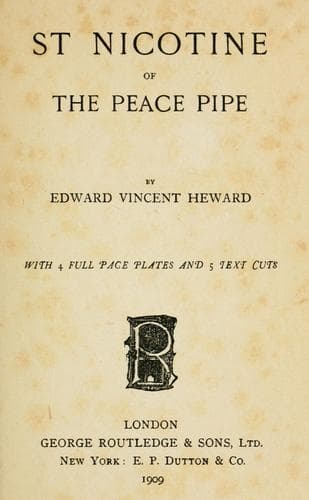
St Nicotine of the Peace PipeHeward, Edward Vincent
History
St Nicotine of the Peace Pipe
Heward, Edward Vincent
Smoking; Tobacco
The temperament of each individual or of a race is an important factor
in a judicious consideration of the subject; it opens out a field of
inquiry of no ordinary interest, more particularly as regards eastern
nations. By temperament physiologists mean certain physical and mental
characteristics arising from the predominant humours of the body. Galen
in the second century was perhaps the first to employ the term to
designate, according to the teachings of the old school, the condition
of the four elements of the body—the blood, choler, phlegm, gall—and
the varying combinations of these, recognised to-day as the sanguine,
lymphatic, nervous, or bilious temperaments. Interest in this aspect of
the subject is heightened when we consider the marvellous effect the
consumption of tobacco has had on races inhabiting Western Asia. Speaking
on this curious point in the Indian Section of the Imperial Institute
in February, 1896, Sir George Birdwood called attention to the change
wrought in the character of the Turks by its use. He remarked that
in ancient times the Scythians were a ceaseless scourge to
the neighbouring nations; that they were referred to by the
prophet Jeremiah as a ‘seething caldron,’ ever boiling over in
fierce and cruel eruptions from the North. Where are they now?
They have become the modern Turks; and the magic which changed
them from restless, destructive nomads into the quiet and only
too conservative sedentary Turks, Von Moltke tells us in his
_Letters from Turkey_ was none other than the acquired American
habit of smoking tobacco.
Coming from so profound an observer of men as the great German
strategist, this testimony to the influence of the Indian weed on human
character is to be accepted as a valuable contribution to our knowledge.
And yet, viewed in the light of recent events in Turkey, the marvellous
transformation mentioned would seem to be hardly yet completed. Besides,
may not other influences tending to modify the character of the Turks
be found in their four centuries of intermarriage with tribes of a
less turbulent disposition, as with Persians and Circassians, than the
fiery, stubborn mountaineers from whom they had descended? It seems
but reasonable to think so. Let us hasten, however, to note that other
distinguished travellers in Turkey speak to the same effect, and that
they, too, attribute the change to the sobering and soothing action of
tobacco upon them. Dr. Madden, whose _Travels in Turkey and Egypt_ were
published in 1829, says (i. 16) that
Public-domain text, read in full here on John Shaqi.
Reviews
Reviews
No reviews yet
Be the first to share your thoughts on this work.
Join the Discussion
Join the discussion
Sign in to leave a comment or review.
Sign InorCreate an account