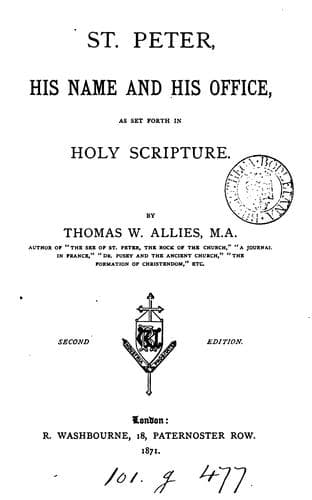
St. Peter, His Name and His Office, as Set Forth in Holy ScriptureAllies, T. W. (Thomas William)
Religion
St. Peter, His Name and His Office, as Set Forth in Holy Scripture
Allies, T. W. (Thomas William)
Peter, the Apostle, Saint
Of Himself He had said, though the Redeemer of all, that He was not
sent, that is, as an Apostle, actually to preach, "save to the lost
sheep of the house of Israel:" and on first sending His Apostles, He
gave them this commission, "Go ye not into the way of the Gentiles,
and into the city of the Samaritans enter ye not, but go ye rather
to the lost sheep of the house of Israel." But when about to ascend
to the Father, He tells them, "You shall receive the power of the
Holy Ghost coming upon you, and you shall be witnesses unto me in
Jerusalem, and in all Judea, and Samaria, and even to the uttermost
part of the earth:"[43] that is, that they should set up His kingdom
through all the world, proceeding by gradual steps, from Jerusalem
to Judea, thence to Samaria, and at length "to every creature" in
the whole world.
Now the history of the Acts shows the exact accomplishment of this
order, and it likewise shows that Simon Peter was the one elected
chief instrument for carrying out these successive propagations of
the Church. What we have said already shows this as to the mother
Church of Jerusalem, and, before proceeding to the Gentile Churches,
we will trace the same instrumentality as used to bring the
Samaritans into the universal kingdom.
The persecution ensuing on the proto-martyr Stephen's death caused,
by our Lord's providence, the dissemination of many believers
through Judea and Samaria, while the Apostles alone remained at
Jerusalem. Amongst those who thus "went about preaching the word of
God," Philip the deacon came to Samaria, and many of the people,
hearing his words and seeing his miracles, were converted and
baptized. But the Church thus commenced by the preaching of the
deacon would have dried up without hope of progress, had it not
received the assistance of those whom Christ had set in the place of
fathers, and who could bestow the gifts of the Holy Ghost. For[44]
"the Church is in the bishop," and, as S. Jerome said of a faction
which had a deacon for its author, "With the man the sect also
perished, because a deacon could ordain no clerk after him. But it
is not a Church which has no priest." Accordingly when[45] "the
Apostles, who were in Jerusalem, had heard that Samaria had received
the word of God, they sent unto them Peter and John," who "laid
their hands upon them, and they received the Holy Ghost." The
providence of Christ, then, so ordered the propagation of His
kingdom as to choose Peter and John to complete and perfect the
Samaritan Church. But was this on equal terms, or is no superior
dignity and authority apparent in Peter over John? A regard to the
words of Luke, and the series of acts recorded, will prevent such a
misconception. For he mentions Peter and John, but he sets Peter
first, and in his record of what happened to Simon John acts the
second part, and it is Peter alone who teaches, commands, judges,
and condemns, with authority, as the head and supreme ruler. Simon
Public-domain text, read in full here on John Shaqi.
Reviews
Reviews
No reviews yet
Be the first to share your thoughts on this work.
Elsewhere in the archive
Join the Discussion
Join the discussion
Sign in to leave a comment or review.
Sign InorCreate an account