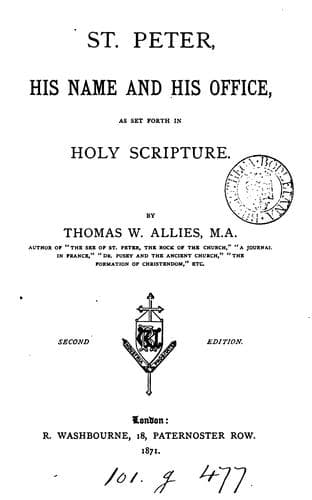
St. Peter, His Name and His Office, as Set Forth in Holy ScriptureAllies, T. W. (Thomas William)
Religion
St. Peter, His Name and His Office, as Set Forth in Holy Scripture
Allies, T. W. (Thomas William)
Peter, the Apostle, Saint
Magus, tempted by beholding the gifts of the Holy Spirit visibly
bestowed on imposition of the Apostles' hands, "offered them money,"
to both Peter and John. But Peter alone replies, and not only so,
but condemns his profaneness, enlarges on his guilt, and solemnly
declares that the gifts of God are not purchaseable with money.
"Keep thy money to thyself to perish with thee, because thou hast
thought that the gift of God may be purchased with money;" he
discloses Simon's secret thoughts, "for thy heart is not right in
the sight of God;" he inflicts on him excommunication, "thou hast no
part nor lot in this matter;" he exhorts him to repent, "do penance
therefore from this thy wickedness, and pray to God, if perhaps this
thought of thy heart may be forgiven thee." Now here John, the next
of the Apostles in rank, is with Peter, yet he does not speak,
teach, or enjoin: Peter does all this singly. He answers Simon's
question, lances and probes the most secret wound of his conscience,
declares how divine gifts are given, proscribes the plague of
simony, orders penance, and inflicts excommunication on a scandalous
public offender. Thus the twenty-second of the Apostolic canons
runs, "If any bishop, priest or deacon, hath obtained this dignity
by money, let him and his ordainer be deposed, and altogether be
deprived of communion, as Simon Magus was by Peter." Nothing but an
inequality of rank between Peter and John will account for Luke's
narration here. But if John was inferior to Peter, much more the
rest.
But there is another proof of his superiority here, in that God
caused Simon Peter to engage Simon Magus. Thus, by His providence,
"reaching from end to end mightily, and ordering all things
sweetly," the first-born of Christ is brought to conflict with the
"first-born of the devil," the chief of teachers with the earliest
of heretics, and prime of that long brood of the evil one, who are
to persecute "the seed of the woman." Thus ancient writers record
that Peter afterwards went to Rome on purpose to expose the acts of
this same Simon. Thus they mention his engaging with the famous
Alexandrine Apion, the enemy of the Jewish and the Christian faith
alike. And hence, too, probably the very ancient writer (whoever he
was) of the Epistle of Clement to S. James, begins it by recording
how "Simon, for his true faith and his firm grounding in doctrine,
was appointed to be the foundation of the Church, and for this very
reason by Jesus Himself with most true augury had his name changed
to Peter, the first-fruits of our Lord, the first of the Apostles,
to whom first the Father revealed the Son, whom Christ with reason
blessed, the called and the elect, His guest and comrade, the good
and the proved disciple, _he who, as the most able of all, was
commanded to illuminate the West, the darker quarter of the world_,
and who was enabled to succeed."
Public-domain text, read in full here on John Shaqi.
Reviews
Reviews
No reviews yet
Be the first to share your thoughts on this work.
Elsewhere in the archive
Join the Discussion
Join the discussion
Sign in to leave a comment or review.
Sign InorCreate an account