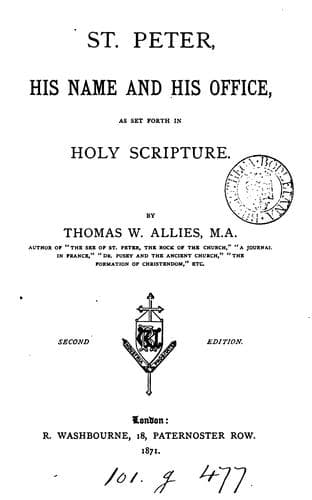
St. Peter, His Name and His Office, as Set Forth in Holy ScriptureAllies, T. W. (Thomas William)
Religion
St. Peter, His Name and His Office, as Set Forth in Holy Scripture
Allies, T. W. (Thomas William)
Peter, the Apostle, Saint
V. But [58]founded as we have seen the Church to have hitherto been,
and at each step of its course advanced, mainly by the authority of
Peter, it could not hope to remain in a vigorous and united state
without the continual exercise of _judicial_ and _legislative_
power, and diligent _inspection_. Nor is there, in fact, one of
these which Peter did not exercise, and that in a manner to indicate
the ruler set over all. For as to the judicial power, do we not hear
him saying, "Tell[59] me whether you sold the land for so much;"
and, "Ananias, why hath Satan tempted thy heart, that thou shouldst
lie to the Holy Ghost, and by fraud keep part of the price of the
land? Whilst it remained did it not remain to thee? And after it was
sold, was it not in thy power? Why hast thou conceived this thing in
thy heart? Thou hast not lied to men but to God." And presently the
sentence comes forth from him who binds in heaven as well as on
earth. "Behold the feet of them who have buried thy husband are at
the door, and they shall carry thee out." Here then we have Peter,
in the midst of the Apostles, yet acting singly as the supreme
judge, and defender of ecclesiastical discipline, on which S.
Chrysostome says, "For Peter was terrible, punishing, and convicting
the thoughts, to whom they adhered the more both for the sign, and
his first speech, and his second, and his third. For he it was who
did the first sign, and the second, and the present, which seems to
me double, one to convict the thoughts, and another to kill with his
command." Then, asking why nobody had announced her husband's death
to Sapphira, "This was fear of the Teacher; this respect of the
disciples; this obedience:"[60] where he is mentioned not as _a_
teacher, but the supreme and chief one.
Yet though the other Apostles were judges, with power to bind and to
loose, though they were present, and concerned, for "Ananias
bringing a certain part, laid it at the feet of the Apostles," not
of Peter only, it was not they, but Peter, who entered on the cause
of Ananias and Sapphira, passed sentence, and inflicted punishment.
Why did he judge singly a cause which was brought before the common
tribunal of the Apostles? Because Peter was to have the Primacy in
all things; because from him the model of ecclesiastical judgments
was to be taken; because the charge of maintaining ecclesiastical
discipline belonged in chief to him as the head.
Public-domain text, read in full here on John Shaqi.
Reviews
Reviews
No reviews yet
Be the first to share your thoughts on this work.
Elsewhere in the archive
Join the Discussion
Join the discussion
Sign in to leave a comment or review.
Sign InorCreate an account