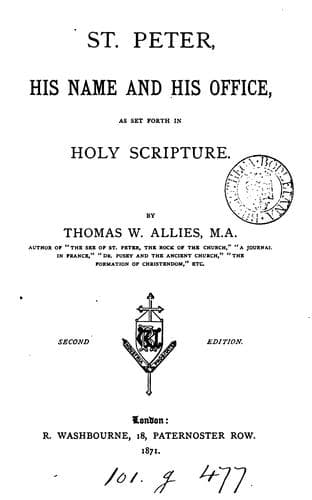
St. Peter, His Name and His Office, as Set Forth in Holy ScriptureAllies, T. W. (Thomas William)
Religion
St. Peter, His Name and His Office, as Set Forth in Holy Scripture
Allies, T. W. (Thomas William)
Peter, the Apostle, Saint
VI. But no less [61]markedly does Luke represent Peter as everywhere
visiting the Churches, providing for them as universal pastor, and
exercising herein the administrative Primacy. "The Churches," he
says, "throughout all Judea, and Galilee, and Samaria, had peace,
being edified and walking in the fear of the Lord, and were
multiplied by the consolation of the Holy Ghost. And it came to pass
_that Peter, as he passed through, visiting all_, came to the saints
who dwelt at Lydda."[62] In illustration of this we may remember
Paul's charge to Titus:[63] "for this cause I left thee in Crete,
that thou shouldst set in order the things that are wanting, and
shouldst ordain priests in every city, as I also appointed thee."
And again, what Luke writes of Paul himself: "After some days Paul
said to Barnabas, Let us return and visit our brethren in all the
cities wherein we have preached the word of the Lord, to see how
they do."[64] And what[65] Eusebius, from S. Clement, relates of S.
John, that he visited with authority the Churches of Asia, which he
had either founded, or specially attended to. By these passages we
see the nature of Peter's visitation, that it was pastoral, and
likewise the difference between his and these others, for they were
_local_, but his _universal_. Titus acted in Crete, the special
sphere of his labour, to which S. Paul the founder of that Church
had appointed him. Paul and Barnabas propose to visit "our brethren
_in every city in which we have preached the word of the Lord_;" S.
John exerts visitatorial power over the churches of that province
wherein he dwelt, and that too, apparently, when he was the sole
survivor of the Apostolic college, yet did not go into other parts.
But Peter's charge is oecumenical, and therefore his visitation
universal. He inspects the labours of others, as well as his own.
For he was not the only Apostle at Jerusalem, nor had he singly
built up all the churches of Judea, Galileo, and Samaria, yet he
alone makes a progress from Jerusalem to all these churches. Though
not the Bishop of Jerusalem, over which the Apostle James presides,
he goes everywhere, as "the Bishop of Bishops."[66] No other reason
coherent with Scripture can we find for this universal inspection of
Peter; for all the Apostles were indeed pastors, but he alone set
over the whole fold; he alone not limited, like Paul, "to the
brethren in every city wherein he had preached." He differs from
all others as the universal from the particular, and so S.
Chrysostome says of him in this very passage, "like a general he
went round surveying the ranks, seeing what portion was well massed
together, what in order, what needed his presence. Behold him making
his rounds in every direction."[67]
Public-domain text, read in full here on John Shaqi.
Reviews
Reviews
No reviews yet
Be the first to share your thoughts on this work.
Elsewhere in the archive
Join the Discussion
Join the discussion
Sign in to leave a comment or review.
Sign InorCreate an account