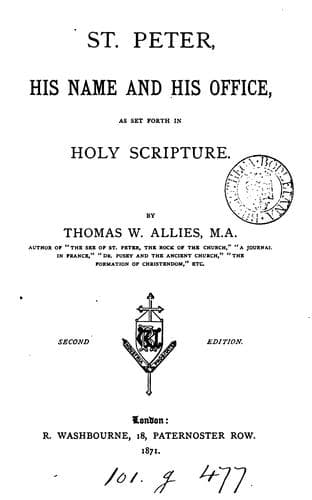
St. Peter, His Name and His Office, as Set Forth in Holy ScriptureAllies, T. W. (Thomas William)
Religion
St. Peter, His Name and His Office, as Set Forth in Holy Scripture
Allies, T. W. (Thomas William)
Peter, the Apostle, Saint
happened alike to James, to Peter, and to Paul, but that Peter held
the place of father in the Lord's family, of commander in His army,
of steward in His household, delivering to each of His servants
their measure of wheat in due season.
The result,[78] then, of our particular enquiry in the Acts is to
demonstrate two things, that Peter discharged the office of Father
and Head in the Lord's family, and that the Church received and
admitted him when so acting, with a consciousness that such was the
will of Christ.
Now this office did not consist in "lording it" over his brethren,
in assuming high titles, and interfering with the ministry of others
when exercised in its due course, in rejecting their assistance, or
impeding the unanimous exercise of their counsel. On the contrary,
the Lord had before prescribed that "the greater" among them should
be as the younger, and "the leader" as he that ministers, proposing
to them Himself as the great model, who had exercised the highest
power with the utmost gentleness, and, being "the Lord," had become
"the servant of all." What, then, did this office of Primate consist
in? We may say that Peter was undoubtedly such, if he constantly
exercised the power of a head in building up the Church, in
maintaining discipline, in reconciling dissensions, and in general
administration. Now it would be doing Peter wrong to suppose that he
usurped as peculiar to himself what equally belonged to all the
Apostles; or that, having received the special power of the Holy
Ghost, he did not fulfil his own advice to others, "not to lord it
over the clergy, but to be made a pattern of the flock."[79] And the
four points just mentioned may be reduced to a triple authority, a
Primacy _magisterial_, _judicial_, and _legislative_. Let us take in
at one glance what has been said of Peter in regard to each of
these.
As to the _magisterial_, or power of authoritative teaching, and
general administration, Peter is constantly taking the lead, he is
the mouthpiece of the Apostles: he alone, or he first, by teaching
plants the Churches; he alone, or he in chief, completes them when
planted; he it is who by divine revelation given to himself,
discloses to the rest the dispensation of God; and he in words full
of power sets forth to these assembled in council the course which
they are to pursue.
As to the _judicial_, none other judgments are found in that portion
of the Acts which contains the history of the whole Church, save
those of which he was either the _sole_ or the _chief_ author. Alone
he took cognisance of Ananias and Sapphira, and alone he punished
them. And Simon he censured in chief, and excommunicated.
As to the _legislative_, Peter alone promulged the law as to
receiving the Gentiles; alone he prescribed that for abrogating the
Mosaic ceremonial ordinances; and he was the chief author of the
decree which expressed in terms his own previous act, and was put
forth in common by the Apostles and Ancients.[80]
Public-domain text, read in full here on John Shaqi.
Reviews
Reviews
No reviews yet
Be the first to share your thoughts on this work.
Elsewhere in the archive
Join the Discussion
Join the discussion
Sign in to leave a comment or review.
Sign InorCreate an account