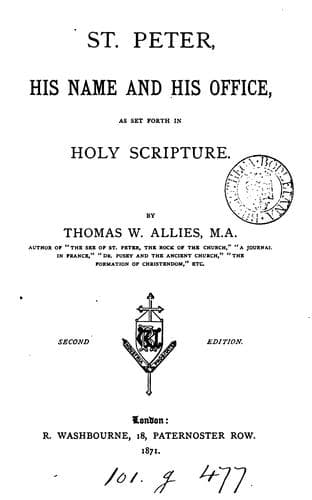
St. Peter, His Name and His Office, as Set Forth in Holy ScriptureAllies, T. W. (Thomas William)
Religion
St. Peter, His Name and His Office, as Set Forth in Holy Scripture
Allies, T. W. (Thomas William)
Peter, the Apostle, Saint
Again, compare the _institution_ of the Primacy with its _exercise_.
Its institution consisted in three things. 1. That Peter was named
by Christ the foundation of the Church, with whom its whole fabric
was most intimately to cohere, and from whom it should derive
visible unity and impregnable strength: 2. That the authority of
universal pastor, and the care of the whole fold, was committed to
him: 3. That to him belonged the confirmation of his brethren, and a
power of the keys to which all were subject. Now consider the
execution.
As foundation of the Church, he gathers up to himself congregations
from the Jews, the Samaritans, and the Gentiles.
As universal pastor, he collects from these three the flock,
nourishes, defends, inspects it, and fills up one place of highest
rank in the ministry forfeited by the traitor.
As confirmer of the brethren, he disclosed to them the heavenly
vision signifying the universal calling of the Gentiles, and the
abrogation of the Mosaic law. He acts in the Lord's household as the
bearer of the keys, going to all parts, defending and inspecting
all. By himself he binds and looses, calling Ananias and Sapphira to
his tribunal, and excommunicating the first heretic.
So exactly, then, do the institution of the Primacy and the acts of
Peter fit into each other, that from the former you may predict the
latter, and from the latter prove the former. They are like cause
and effect, or an a priori and an a posteriori argument. They are a
reciprocal confirmation to each other; just as if by time you
calculate the sun's rising, and see the diffusion of his light, from
his having risen you infer his light, and from his light conclude
that he has risen.
Nor in the Apostolic Church does any one appear to resist or
question this office of Peter. Rather upon him all eyes are fixed,
for him all are anxious; no Abiram rises up against him with the
words of rebellion; "Thou takest too much upon thee, seeing all the
congregation are holy, every one of them, and the Lord is among
them, wherefore then liftest thou up thyself above the congregation
of the Lord?"[81] No Aaron in a moment of delusion cries, "Did the
Lord speak by Moses only? hath He not spoken also by us?"
Yet Peter acts not like one out of a number, and occasions of
contention are not wanting, strong prepossessions and keen
feelings.[82] He is everywhere; his pre-eminence and his control are
universal: he can act with severity, and there are some impatient
even of a just control. When Ananias and Sapphira fell dead at his
feet, none murmured. When he exclaimed, in full council, "now,
therefore, why tempt you God?" the whole multitude was silent. When
he explained the reception of the Gentiles, those who had murmured
"held their peace, and glorified God."[83]
Public-domain text, read in full here on John Shaqi.
Reviews
Reviews
No reviews yet
Be the first to share your thoughts on this work.
Elsewhere in the archive
Join the Discussion
Join the discussion
Sign in to leave a comment or review.
Sign InorCreate an account