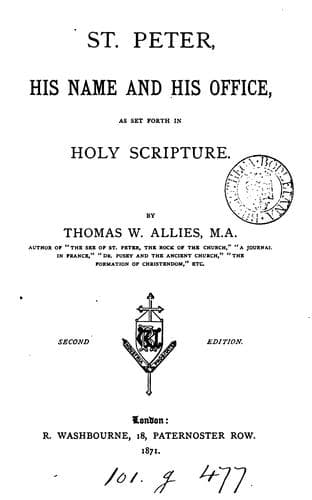
St. Peter, His Name and His Office, as Set Forth in Holy ScriptureAllies, T. W. (Thomas William)
Religion
St. Peter, His Name and His Office, as Set Forth in Holy Scripture
Allies, T. W. (Thomas William)
Peter, the Apostle, Saint
[43] Matt. xv. 24; x. 5; Acts i. 8.
[44] St. Cyprian, Ep. 69. St. Jerome, dialogue con. Luciferianos.
[45] Acts viii. 14.
[46] Passaglia, p. 174.
[47] Eph. iii. 5; Mal. i. 11.
[48] Acts ix. 32.
[49] Bede on this text.
[50] Apoc. vii. 9.
[51] Haer. 28, s. 3.
[52] Hom. 24 on the Acts, n. 1.
[53] John iv. 2.
[54] Passaglia, p. 181.
[55] Acts xi. 1-4.
[56] On Acts, Hom. 24, n. 2.
[57] Lib. 9. Ep. 39.
[58] Passaglia. p. 188.
[59] Acts v. 8. 3.
[60] On Acts, Hom. 12.
[61] Passaglia, p. 190.
[62] Acts ix. 31.
[63] Titus i. 5.
[64] Acts xv. 36.
[65] Hist. Ecc. Lib. 3, ch. 23.
[66] So called by Arnobius, on psalm 138.
[67] On Acts, Hom. 21, n. 2.
[68] Passaglia, p. 192.
[69] Acts xv. 6.
[70] Hom. 32, n. 1.
[71] Hom. 32, Tom. 9, p. 250.
[72] Acts xv. 28; xvi. 4.
[73] De Pudicitia, c. 21.
[74] S. Jerome, Ep. 75, inter Augustinianas, Tom. 2, p. 171.
[75] Theodoret, Ep. 113, Tom. 3, 984.
[76] Passaglia, p. 197.
[77] On Acts, Hom. 26, n. 2.
[78] Passaglia, p. 198.
[79] 1 Pet. v. 3.
[80] Princeps hujus fuit decreti, says St. Jerome to St. Augustine,
Ep. 75, n. 8. inter Augustinianas.
[81] Numbers xvi. 3; xii. 2.
[82] Acts vi. 1; xv. 2; xi. 2.
[83] Acts xi. 18.
[84] Eph. i. 22; iv. 15; v. 23, 27.
[85] Col. i. 18.
CHAPTER VI.
TESTIMONY OF S. PAUL TO S. PETER'S PRIMACY.
In leaving the Gospels and the Acts we quit those writings in which
we should expect, beforehand, that divine government to be set
forth, which it pleased our Lord to establish for His church. In
exact accordance with such expectation we have seen the institution
of the apostolic college, and of S. Peter's Primacy over it,
described in the Gospels, and the history in the Acts of its
execution and practical working. Both institution and execution have
been complete in their parts, and wonderfully harmonise with each
other. But in the other inspired writings of the New Testament,
comprising the letters of various Apostles, and specially of S.
Paul, we had no reason to anticipate any detailed mention of Church
government. The fourteen Epistles of S. Paul were written
incidentally on different subjects, no one of them leading him to
set forth, with any exact specification, that divine hierarchy under
which it was the pleasure of the Lord that His Church should grow
up. Moreover, it so happened that the [1]circumstances of S. Paul's
calling to be an Apostle, and the opposition which he sometimes met
with from those attached to Jewish usages, caused him to be a great
defender of the Apostolic dignity, as bestowed upon himself, and
continually to assert that he received it not of men, but of God.
Had there, then, been no recognition at all of S. Peter's superior
rank in the Apostolic College to be found in his writings, it would
not have caused surprise to those who consider the above reasons.
And proportionably strong and effective is the recognition of that
rank, which, though incidental, does occur, and that several times.
If, then, S.
Public-domain text, read in full here on John Shaqi.
Reviews
Reviews
No reviews yet
Be the first to share your thoughts on this work.
Elsewhere in the archive
Join the Discussion
Join the discussion
Sign in to leave a comment or review.
Sign InorCreate an account