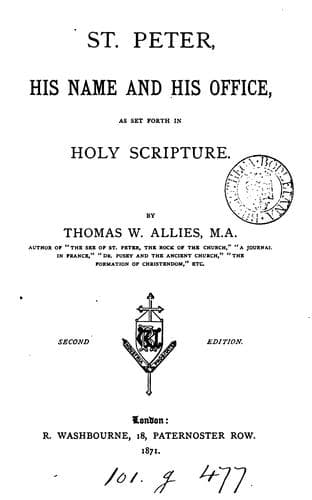
St. Peter, His Name and His Office, as Set Forth in Holy ScriptureAllies, T. W. (Thomas William)
Religion
St. Peter, His Name and His Office, as Set Forth in Holy Scripture
Allies, T. W. (Thomas William)
Peter, the Apostle, Saint
Paul, being so circumstanced, selected expressions
which seem to indicate a distinction of dignity between the Apostles
and S. Peter, they claim a special attention, and carry a double
force. Now on putting these together we shall find that they show
not merely a distinction of dignity, but a superior authority, in
Peter.
The first are four several passages in the first Epistle to the
Corinthians, in all of which S. Peter holds the higher place, and in
two is moreover mentioned singly, while the rest are mentioned only
in mass. These are the following, "Now this I say, that every one of
you saith: I indeed am of Paul; and I of Apollo; and I of Cephas;
and I of Christ." Again: "All things are yours, whether it be Paul,
or Apollo, or Cephas, or the world, or life, or death, or things
present, or things to come, for all are yours, and you are Christ's,
and Christ is God's." Again, "Have we not power to carry about a
woman, a sister, as well as the rest of the Apostles, and the
brethren of the Lord, and Cephas?" And once more: "That He was seen
by Cephas, and after that by the eleven."[2] First, we may remark
that the place of dignity in a sentence varies[3] according to its
nature: if it _descends_, such place is the first; but if it
_ascends_, it is the furthest point from the first. Now in the first
instance the discourse ascends, for what can be plainer than that it
terminates in Christ, as in the supreme point? "Every one of you
saith, I indeed am of Paul, and I of Apollo, and I of Cephas, and I
of Christ;" so S. Chrysostome observes, "It was not to prefer
himself before Peter that he set him last, but to prefer Peter even
greatly before himself. For he speaks in the ascending scale:" and
Theodoret: "They called themselves from different teachers: now he
mentioned his own name and that of Apollo: but he adds also the name
of the chief of the Apostles."[4] As plain is this in the second
instance, where S. Paul, developing his thought, "all things are
yours," adds, "whether Paul, or Apollo, or Cephas," or if that be
not sufficient, "the world" itself, which, carried away in a sort of
transport, he seems to divide into its parts, "or life, or death, or
things present, or things to come, all," I repeat, "are yours:" but
only, you are not your own, "you are Christ's, and Christ is God's."
In all which, from human instruments, who plant and water, he rises
up to God, the ultimate source, the beginning and the end. Stronger
yet is the third passage, for being in the very act of setting forth
the dignity of his own Apostolate, "have we not power," he says, "to
lead about a sister, a woman, as well as the rest of the Apostles,
and the brethren of the Lord, and Cephas?" Now, whether "the rest of
the Apostles" here means, those who, in the looser signification are
so called, as "the Apostles of the Churches," and "Andronicus, and
Junias--who are of note among the Apostles,"[5] or the original
Twelve, the ascending scale is equally apparent.
Public-domain text, read in full here on John Shaqi.
Reviews
Reviews
No reviews yet
Be the first to share your thoughts on this work.
Elsewhere in the archive
Join the Discussion
Join the discussion
Sign in to leave a comment or review.
Sign InorCreate an account