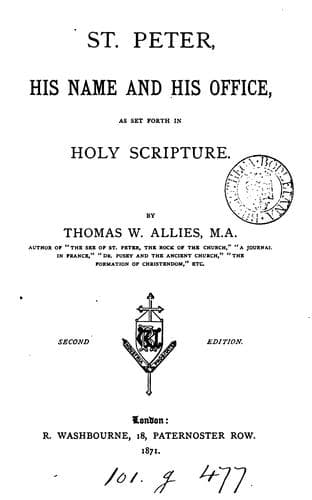
St. Peter, His Name and His Office, as Set Forth in Holy ScriptureAllies, T. W. (Thomas William)
Religion
St. Peter, His Name and His Office, as Set Forth in Holy Scripture
Allies, T. W. (Thomas William)
Peter, the Apostle, Saint
the step, by which through Him we may be able to mount unto Him:"
"the descent of the Creator to the creature is the advance of
believers to things eternal:" and, "it is not doubtful that man's
nature has been taken into such connection by the Son of God, that,
not only in that Man who is the first-born of all creation, but even
in all His saints, there is one and the same Christ: and as the Head
cannot be divided from the limbs, so neither the limbs from the
Head. For though it belong not to this life, but to that of
eternity, that God be all in all, yet even now He is the undivided
inhabitant of His temple, which is the Church." For all the above is
contained in our Lord's own words, "that they all may be one, as
Thou, Father, in Me, and I in Thee," on which S. Athanasius[13]
says, "that all, being carried by Me, may be all one body and one
spirit, and reach the perfect man:"--"for, as the Lord having
clothed Himself in a body, became man, so we men are deified by the
Word, being assumed through His flesh." S. Gregory,[14] of Nyssa,
has unfolded this idea thus: "since from no other source but from
our lump was the flesh which received God, which, by the
resurrection, was together with the Godhead exalted; just as in our
own body the action of one organ of sense communicates sympathy to
all that which is united with the part, so, just as if the whole
nature (of man) were one living creature, the resurrection of a part
passes throughout the whole, being communicated from the part to the
whole, according to the nature's continuity and union." And
another,[15] interpreting the words, "that they all may be one,"
"thus I will, that they being drawn into unity, may be blended with
each other, and becoming as one body, may all be in Me, who carry
all in that one temple which I have assumed; the temple, namely, of
His Body." And lastly, S. Hilary[16] deduces this not only from the
Incarnation, but from the Blessed Eucharist. "For, if the Word be
really made flesh, and we really receive the Word as flesh, in the
food of the Lord, how is He not to be thought to remain in us
naturally, since, both in being born a man, He assumed the nature of
our flesh, never to be severed from Him, and has joined the nature
of His flesh to the eternal nature under the sacrament of the flesh
to be communicated to us."
Public-domain text, read in full here on John Shaqi.
Reviews
Reviews
No reviews yet
Be the first to share your thoughts on this work.
Elsewhere in the archive
Join the Discussion
Join the discussion
Sign in to leave a comment or review.
Sign InorCreate an account