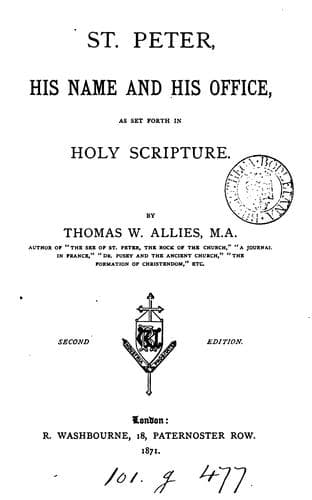
St. Peter, His Name and His Office, as Set Forth in Holy ScriptureAllies, T. W. (Thomas William)
Religion
St. Peter, His Name and His Office, as Set Forth in Holy Scripture
Allies, T. W. (Thomas William)
Peter, the Apostle, Saint
So deep in the junction of the divine and human natures in our
Lord's adorable Person lies the root of unity for that humanity
which He purchased with His blood. It is in virtue of this headship
that the whole mystical body is one, and "we all members one of
another." By this headship our Lord nourishes and cherishes the
Church, and communicates to her incessantly that stream of grace by
which she lives. And as this headship flows from the union of the
Godhead and Manhood, so it is inseparable from His Person, and
incommunicable. But He has Himself, in His parting discourse,
recorded by S. John, dwelt upon the great sacrament of unity, the
result of this headship, and set it forth as the sign and seal of
His own divine mission, and the one convincing proof of His
religion's superhuman origin. By following His words we shall see
that this unity is not simple but fourfold, and we shall trace the
mutual relation and subordination to the divine Headship of its
several kinds.
1. And first, "In[17] that day," says He, that is, after His own
resurrection, "ye shall know that I am in My Father, and you in Me,
and I in you," whereby He declares that, in the completion of the
dispensation, the union between Himself and the faithful shall be
such as to image out the mutual indwelling of the Father and the
Son. Which again is further expressed, "I[18] am the true vine, and
My Father is the husbandman. Every branch in Me that beareth not
fruit He will take away: and every one that beareth fruit, He will
purge it, that it may bring forth more fruit.... I am the vine; you
the branches: he that abideth in Me, and I in him, the same beareth
much fruit: for without Me you can do nothing. If any one abide not
in Me, he shall be cast forth as a branch, and shall wither, and
they shall gather him up and cast him into the fire, and he burneth.
If you abide in Me, and My words abide in you, you shall ask
whatever you will, and it shall be done unto you." In these words He
sets forth that union of mystical influx, by cooperation with which
His disciples keep His words and abide in His love, and of which He
is Himself the immediate principle.
Public-domain text, read in full here on John Shaqi.
Reviews
Reviews
No reviews yet
Be the first to share your thoughts on this work.
Elsewhere in the archive
Join the Discussion
Join the discussion
Sign in to leave a comment or review.
Sign InorCreate an account