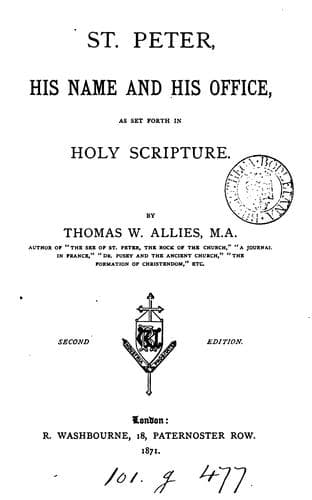
St. Peter, His Name and His Office, as Set Forth in Holy ScriptureAllies, T. W. (Thomas William)
Religion
St. Peter, His Name and His Office, as Set Forth in Holy Scripture
Allies, T. W. (Thomas William)
Peter, the Apostle, Saint
Thus, then, we have been brought by the words both of our Lord and
of S. Paul, through an inward invisible unity, that of mystical
influx from the vine to its branches, and again, that of charity,
and that of faith and truth, to an outward and visible unity, one of
social organization, called forth by the great Head for the purpose
of exhibiting, defending, maintaining, and conveying the former,
since it is expressly said that He gave it "for the perfecting of
the saints, unto the work of the ministry, unto the edifying of the
body of Christ," and in order that "we may be no more children
tossed to and fro, and carried about by every wind of doctrine." And
the inward source and cause of this unity are indeed invisible,
being the Holy Spirit of God, sent down by Christ, when He ascended
up on high, to dwell permanently among men, but its effects are
external and most visible, even the growth of a body "unto a perfect
man, unto the measure of the age of the fulness of Christ," a body
which has an orderly arrangement of all its parts, and a hierarchy
of officers to continue till the end of all. And the function of
this hierarchy is one never to be superseded, and which none but
itself, the organ of the Holy Spirit, can perform, namely, to bring
its members "to meet in the unity of the faith, and of the
knowledge of the Son of God." As our Lord says, in the promise,
before His passion, "I will ask the Father, and He shall give you
(the Apostles) another Paraclete, that He may abide with you for
ever, the Spirit of truth," so S. Paul of the accomplishment after
His ascension, "He gave some Apostles and some prophets, and other
some evangelists, and other some pastors and doctors," yet "all
these things worketh one and the same Spirit." For as the divine
Head took to Himself a body, bridging thereby the worlds of matter
and of spirit, and as "in Him dwelt all the fulness of the Godhead
_corporally_," so in His Church, in perfect analogy with the
Archetype, the visible is the channel of the invisible, and the
outward organization is instinct with inward life, and the hierarchy
is the gift of the mystical Head, and the instrument of the one
sanctifying Spirit. To think otherwise, to disregard the external
framework, under a pretence of exalting the inward spirit, is to
undo so far the work of the Incarnation, and to renew the insanity
of those early heretics who in one way or another would "dissolve"
Christ; for there is no less "one Body," than there is "one Spirit."
Public-domain text, read in full here on John Shaqi.
Reviews
Reviews
No reviews yet
Be the first to share your thoughts on this work.
Elsewhere in the archive
Join the Discussion
Join the discussion
Sign in to leave a comment or review.
Sign InorCreate an account