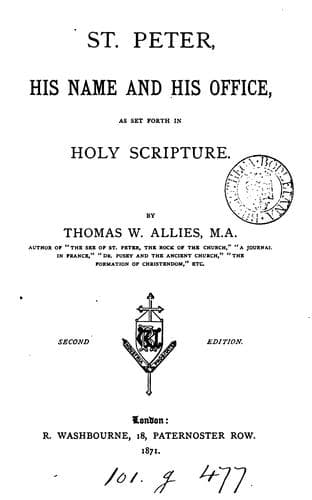
St. Peter, His Name and His Office, as Set Forth in Holy ScriptureAllies, T. W. (Thomas William)
Religion
St. Peter, His Name and His Office, as Set Forth in Holy Scripture
Allies, T. W. (Thomas William)
Peter, the Apostle, Saint
But if His headship of mystical influx is _alone_ and _immediately_
sufficient, as is so often objected, for the maintenance of external
unity, to what end is the creation of this visible hierarchy? For
the objection that the invisible headship of Christ renders a
visible headship unnecessary, and indeed an infringement on His sole
divine prerogative, whatever force it may have, tells not more
against an oecumenical head of the Church, than against every order
and officer of the hierarchy. These all, and with them the whole
system of sacraments as well as symbols, become alike unnecessary
and even injurious, if each member of the mystical body be knit to
Christ _immediately_ without any outward framework. And with what
face especially can those maintain that the bishop is the visible
head of each diocese, and in being such does not contradict, but
illustrate, the headship of Christ, who yet deny that there is one
in the whole Church put in the like place over bishops, and see in
such an appointment an infringement on the office of Christ? Such an
argument is so profoundly illogical and inconsistent, that one has
difficulty in believing it to be seriously held, or is hopeless of
bringing conviction to those who cannot see an absurdity.
Let those, then, who confound together the supreme Headship of
Christ over His Church, whereby He communicates to it life and
grace, with the inferior and subordinate headship of external unity,
see to what their objection tends. It stops at nothing short of
destroying the whole visible hierarchy, and the sacramental grace of
which it is the channel. Holy Scripture, on the contrary, tells us
in these passages that the providence by which the Church is
governed resembles that by which this outward universe is ruled, in
the subordination of second causes to the supreme cause. Christ
repeats as Redeemer His work as Creator, to give life and force to
these second causes, and while He works in the members of His body
both "to will and to do," bestows on them the privilege of
cooperating with Him. Thus the dignity of supreme Head which belongs
to Christ, and is incommunicable, no more takes away the ministry of
the external head who is charged with the office of effecting and
maintaining unity, than it impedes the ministry of "apostles,
prophets, evangelists, pastors, and doctors," to whom Christ
entrusted the Church, that by their means it might be brought to
sanctity and perfection.
Public-domain text, read in full here on John Shaqi.
Reviews
Reviews
No reviews yet
Be the first to share your thoughts on this work.
Elsewhere in the archive
Join the Discussion
Join the discussion
Sign in to leave a comment or review.
Sign InorCreate an account