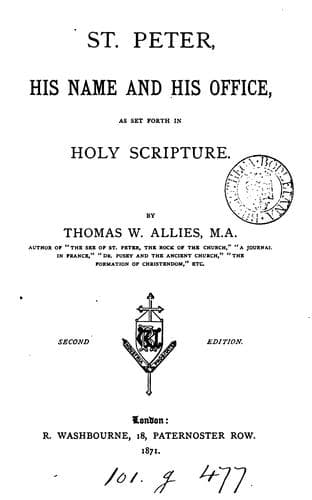
St. Peter, His Name and His Office, as Set Forth in Holy ScriptureAllies, T. W. (Thomas William)
Religion
St. Peter, His Name and His Office, as Set Forth in Holy Scripture
Allies, T. W. (Thomas William)
Peter, the Apostle, Saint
[13] S. Athanasius, Orat. 3, Contr. Arian. Tom. 1, p. 572. Oxf.
Trans. p. 403.
[14] Greg. Nyss. Tom. 2, p. 524. Catechet Oratio, c. 32.
[15] Ephrem, Patriarch of Antioch, quoted by Photius, cod. 229.
[16] S. Hilary, de Trin. Lib. 8. n. 13.
[17] John xiv. 20.
[18] John xv. 1-2, 5-7.
[19] John xiii. 34-6.
[20] John xv. 12.
[21] Rom. v. 5.
[22] John xiv. 16-18. 26.
[23] John xvi. 7. 13-15.
[24] 1 Cor. xii. 11; Eph. iv. 13.
[25] Eph. iv. 7-16; 1 Cor. xii. 7-13.
[26] Passaglia, p. 254.
[27] 1 Cor. x. 17.
[28] Mansi, Concil. Tom. 8, 208.
[29] S. Cyprian, de Unitate.
[30] Eph. iv. 4. 8. 11; i. 22; v. 23.
[31] That such was the belief of the most ancient fathers, Ignatius,
Irenaeus, Tertullian, Cyprian, and others, see a most curious
admission of the Lutheran Mosheim, in his dissertation, De Gallorum
appellationibus, &c. s. 13. And his way of extricating himself is at
least as curious as the admission. His words are, "Cyprian and the
rest cannot have known the corollaries which follow from their
precepts about the Church. For no one is so dull as not to see that
between a certain unity of the universal Church, terminating in the
Roman pontiff, and such a community as we have described out of
Irenaeus and Cyprian, there is scarcely so much room as between hall
and chamber, or between hand and fingers. If the _innocence_ of the
first ages stood in the way of their anticipating the snares which
ignorantly and unintentionally they were laying against sacred
liberty, those succeeding at least were more sharp-sighted, and it
was not long in becoming clear to the pontiffs what force in
establishing their own power and authority such tenets possessed."
So the ancient fathers were not intelligent enough to see that _the
hand was joined to the fingers_. But the other alternative was still
harder to Mosheim, that Lutheranism was fundamentally heretical and
schismatical.
[32] Napoleon.
CHAPTER VIII.
SUMMARY OF PROOF GIVEN FOR S. PETER'S PRIMACY.
It would now seem to be made clear to all that the controversy on S.
Peter's Primacy relates _generally_ to the question of inequality in
the Apostolic college, and _specially_ to the question, whether
Christ, the Founder of the Church, set any one of the Apostles, and
whom of them in particular, over the rest. For as, on the one hand,
there would have been no room for the superior dignity of the
Primacy, had all the Apostles been completely equal, and
undistinguished in honour and authority from each other; so, on the
other hand, it is the nature of the Primacy to be incapable of even
being contemplated, save as fixed on some certain definite subject.
But to determine the two questions, whether the Apostles stood, or
did not stand, on a complete equality, and whether one of them was
superior to the rest in honour and dignity, it seemed requisite to
examine chiefly four points.
First, the words and the acts of Christ respecting the Apostles.
Public-domain text, read in full here on John Shaqi.
Reviews
Reviews
No reviews yet
Be the first to share your thoughts on this work.
Elsewhere in the archive
Join the Discussion
Join the discussion
Sign in to leave a comment or review.
Sign InorCreate an account