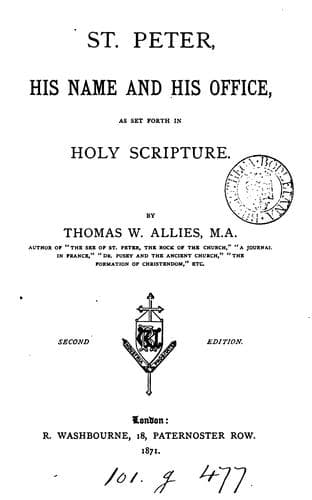
St. Peter, His Name and His Office, as Set Forth in Holy ScriptureAllies, T. W. (Thomas William)
Religion
St. Peter, His Name and His Office, as Set Forth in Holy Scripture
Allies, T. W. (Thomas William)
Peter, the Apostle, Saint
_of the Body_."[30]
But if this be so, we can say nothing more highly to exalt S.
Peter's office in the Church, for he is the great bond and stay of
this outward unity, as even[31] enemies confess. As surely as in a
real monarchy the person of the sovereign ties together every part
of the political edifice, and is endued with majesty because he is
at once the type of God, and concentrates in one the power and
dignity of the whole community, so it is in that divine structure in
which "the manifold wisdom of God" is disclosed to all creation. The
point of strength is felt alike by friend and foe. On the Rock of
Peter has fallen every storm which the enmity of the evil one has
raised for eighteen hundred years; but yet the gates of hell have
not prevailed against it. In the Rock of Peter, and the divine
promise attached to it, every heart faithful to God and the Church
trusts now, as it trusted from the beginning. Many temporal monarchs
in their hour of pride have risen against S. Peter's See, but the
greatest of them all[32] declared that no one had ever gained honour
or victory in that conflict, and he lived to be the most signal
instance of his own observation. "God is patient, because He is
eternal," and the Holy See prevails in its weakness over power, and
in its justice over cupidity, because while temporal dominion passes
from hand to hand, and stays not with any nation, following the
gift of God which the poet calls fortune,
Perche una gente impera, e l'altra langue,
Seguendo lo giudizio di costei
Che e occulta, come in l'erba l'angue,--(DANTE, _Inferno_.)
the visible kingdom of Christ, which is His Church, lasts for ever,
and is built upon the rock of Peter. The long line of descendants,
from Constantine and from Charlemagne, have in their turn impugned
and illustrated this glorious privilege of the Papal See. What is
there so stable in an empire of commerce, or so solid in the
nicely-balanced and delicate machinery of a constitutional monarchy,
as to exempt them from the action of an universal law, or to ensure
their victory in the doomed contest with the Vicar of Christ?
Mightier things than they have done their worst, have oppressed,
triumphed, and become extinct, and if it be allowed them in the
crisis of their trial to crucify Christ afresh, He will yet reign
from the cross, and "draw all men unto Him."
FOOTNOTES:
[1] In this chapter I have availed myself of Passaglia, b. 1, c. 25,
and b. 2, c. 11.
[2] Eph. i. 9, 22; 1 Cor. xi. 2; Rom. xii. 5.
[3] See Petavius, De Incarn. Lib. 2, c. 7 and 8, for the following
quotations.
[4] Hippolytus, quoted by Anastasius, p. 216.
[5] Irenaeus, Lib. iii. 18, and iv. 37.
[6] De Monogamia, c. 5.
[7] Augustine, 21 Tract. in Joannem.
[8] Hilary on Psalm 68.
[9] S. Chrys. Tom. 5, (Savile) Hom. 106.
[10] Greg. Naz. Orat. 36.
[11] S. Cyril, Dialog. 1, De Trin. p. 399.
[12] S. Leo. 5 Serm. on Nativity, c. 4 and 5, 12th Serm. on Passion,
c. 3.
Public-domain text, read in full here on John Shaqi.
Reviews
Reviews
No reviews yet
Be the first to share your thoughts on this work.
Elsewhere in the archive
Join the Discussion
Join the discussion
Sign in to leave a comment or review.
Sign InorCreate an account