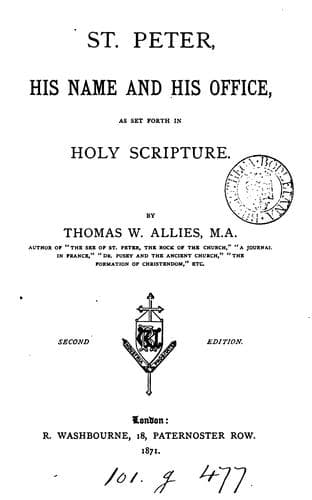
St. Peter, His Name and His Office, as Set Forth in Holy ScriptureAllies, T. W. (Thomas William)
Religion
St. Peter, His Name and His Office, as Set Forth in Holy Scripture
Allies, T. W. (Thomas William)
Peter, the Apostle, Saint
Now the same reason which existed for instituting particular bishops
to govern and preserve in unity particular flocks, moved Christ to
institute an universal Primate, and to set him over the whole fold.
If in the former case the best description of a particular Church is
that of S. Cyprian, "A people united to its priest, and a flock
adhering to its pastor;"[17] in the latter the _form of unity_,
which Christ established in the universal Primate, no less imposes
on all, both taught and teachers, the necessity of saying with S.
Jerome, "I following none as the first save Christ, am joined in
communion with your blessedness, that is, with the chair of Peter.
Upon that rock the Church is built, I know. Whoever outside of this
house eateth the lamb, is profane. If any one was not in the ark of
Noah, he shall perish. I know not Vitalis; I reject Meletius; I am
ignorant of Paulinus. Whoever gathers not with thee, scatters: that
is, he who is not of Christ is of Antichrist."[18]
III. A great accession of evidence will accrue to what we have said
if we attentively consider the reasons deduced from the texts
containing the institution of the Primacy, and those proceeding from
the inherent properties of the Church. To speak of the texts first:
1. Either they carry no meaning with them, or they prove at least
this, that Christ, in instituting the Primacy, intended,[19] while
exhibiting the whole Church under the usual image of a house and
building, to give it a _foundation_, the bond at once of its
strength and unity; and, again, while communicating to one the
special gift of unwavering faith, to make him the channel for
establishing and[20] _confirming_ all the faithful; to[21] render
the fold which he had gathered out of all nations one by the unity
of a supreme visible _pastor_, and to[22] constitute in the Lord's
family, amid so manifold a distinction of officers, one of such
eminence as to be _the Ruler_ and _the Greater_ among all.
But can we, or ought we, to conclude from this as to the purpose of
the Primacy, and as to its constituent force and principle?
Assuredly these texts prove directly and categorically that the
Primacy was set up as _the efficient principle_, whereby to mould
the Church's visible unity, and was endowed with all that authority,
without which unity could neither have been produced, nor maintained
in existence.
Public-domain text, read in full here on John Shaqi.
Reviews
Reviews
No reviews yet
Be the first to share your thoughts on this work.
Elsewhere in the archive
Join the Discussion
Join the discussion
Sign in to leave a comment or review.
Sign InorCreate an account