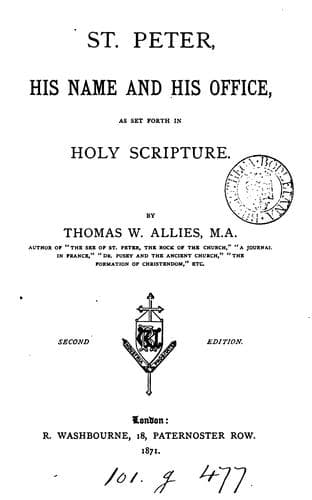
St. Peter, His Name and His Office, as Set Forth in Holy ScriptureAllies, T. W. (Thomas William)
Religion
St. Peter, His Name and His Office, as Set Forth in Holy Scripture
Allies, T. W. (Thomas William)
Peter, the Apostle, Saint
2. And in this judgment we shall be confirmed if we investigate the
properties of which the Church cannot be deprived, without taking a
form and an appearance different from that which it received from
Christ. The first which occurs is that _identity_ by which the
Church must always be like itself, and cannot be substantially
different at its beginning and in its growth; one thing when it had
Christ for its visible head, and another when His words had come to
pass, "A little while, and now you shall not see Me--because I go to
the Father." Now at its first commencement, in the time of our
Lord's mortal life, the Church presented the form of a society
governed by the supreme power of one, and deriving its visible unity
from one supreme visible head. That it might not subsequently lose
this identity, and put on another form, our Lord chose a Primate to
be the principle of visible unity, and to have the power of a head
over the whole body.
And indeed this was necessary to maintain the double character and
test of[23] _unity_ and[24] _Catholicity_, by which the Church is
distinguished in Holy Scripture and in the records of Christian
antiquity. As to _unity_, not only are the expressions in the
creeds, and the more ample explanation of them in the[25] Fathers,
most clear and emphatic, but likewise what is said in the Holy
Scriptures of the _end_ for which the Church was founded by Christ.
For the[26] grace of God our Saviour hath appeared to all men,
instructing those who had[27] changed the truth of God into a lie,
and liked not to have God in their knowledge, that[28] denying all
these things they might become an acceptable people, and[29]
enlightened by Christ, and sanctified in the truth, might by the
profession of one faith be[30] one body and one spirit, in the
same[31] manner in which the Father and the Son are one, and might
be[32] divided by no sects and dissensions, which are manifestly the
works of the flesh, not of God, who is not the[33] God of dissension
but of peace. For therefore[34] Christ, the only-begotten of the
Father, gave His blood for it, to present it to Himself, a glorious
Church, not having spot, or wrinkle, or any such thing, which would
break peace, and disturb the agreement of faith; but that it should
be holy and without blemish,[35] immovable through that rock on
which it rests, and against which not even the gates of hell shall
prevail; wisely ordered as the[36] house of God, in which[37] all
hear his voice, who is set over as the[38] ruler, and has received
his brethren to be[39] confirmed, and the[40] care of the whole
flock;[41] endued with virtue from on high, and strengthened by
the[42] Spirit of truth who proceeds from the Father; possessing the
power of[43] authoritative teaching, which if any[44] hear not, nor
obey, they are to be accounted as heathens and publicans, by a
judgment which binds both in heaven and on earth. Are there any who
do not see that in this description, which sets forth the Church's
Public-domain text, read in full here on John Shaqi.
Reviews
Reviews
No reviews yet
Be the first to share your thoughts on this work.
Elsewhere in the archive
Join the Discussion
Join the discussion
Sign in to leave a comment or review.
Sign InorCreate an account