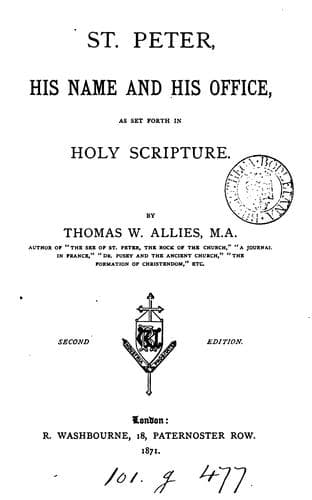
St. Peter, His Name and His Office, as Set Forth in Holy ScriptureAllies, T. W. (Thomas William)
Religion
St. Peter, His Name and His Office, as Set Forth in Holy Scripture
Allies, T. W. (Thomas William)
Peter, the Apostle, Saint
But for this what are their authorities? Can they allege the most
ancient Fathers in unbroken succession from the Apostles? Nay, they
candidly confess that the Fathers thought external and visible unity
simply and absolutely necessary, and not those only of the fourth
and fifth century, but those of the second and third. Witness
Vitringa,[61] who says, "If we consult on this point the doctors of
the ancient Christian Church, they seem on all hands to have
embraced the view that the communion of believers in holy rites, in
the supper of the Lord, and in reciprocal offices of brotherly love,
was maintained absolutely, not hypothetically. They supposed, and
seem to have persuaded themselves, that all who were joined to the
Christian Church by the due rite of baptism after previous
preparation, were really regenerated by the grace of the Holy
Spirit, and so that the Christian Church was an assembly of men,
who in far greater part, saving hypocrites, of whom a few might
exist in secret, participated in the renewing and sanctifying grace
of the Holy Spirit. Accordingly, to be joined to the Church was much
the same as being joined to the heavenly city. To have one's name on
the Church's books, much the same as to have it in God's book of
life. On the other hand, to be severed from Church communion, or to
use Tertullian's words, "to be deprived of the sacrament of the Body
and Blood of the Lord, and to be debarred from all brotherly
communion," was to risk salvation, and incur the danger of eternal
death. That is, they supposed that no one was saved out of the
external communion of the Church, which they confounded with the
mystical and spiritual communion of the Saints. And again, kindred
points to these, and resting on the same principle, that bishops
represent the office and person of Jesus Christ Himself in the
Christian Church; that those who separated themselves from them when
rightly and duly elected, separated themselves at the same time from
the communion of Christ Himself. That those who were absolved by the
bishops after penance publicly performed according to the canons of
ecclesiastical discipline, restored to their rank, and honoured with
the kiss of peace, were absolved in the heavenly court by God
Himself, and Christ the Judge. Lastly, which was the most[62]
_audacious_ of all such hypotheses, that it was all over with the
salvation of all who separated themselves in schism from the
external communion of the Church and its rites, although hitherto
they had neither been tainted with heresy, nor involved in crimes
destructive of the Christian[63] profession. It would be easy for me
to support at length each one of these particulars by the sentiments
and the discipline of the doctors of the primitive Church, were they
unknown to the more instructed, or did my purpose allow it. I now
only appeal to Cyprian's letter to Magnus, in the whole of which He
supposes and urges the very hypotheses which I have been
Public-domain text, read in full here on John Shaqi.
Reviews
Reviews
No reviews yet
Be the first to share your thoughts on this work.
Elsewhere in the archive
Join the Discussion
Join the discussion
Sign in to leave a comment or review.
Sign InorCreate an account