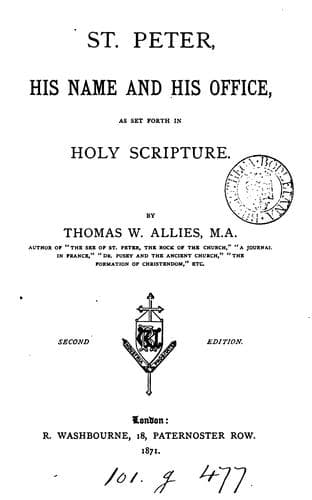
St. Peter, His Name and His Office, as Set Forth in Holy ScriptureAllies, T. W. (Thomas William)
Religion
St. Peter, His Name and His Office, as Set Forth in Holy Scripture
Allies, T. W. (Thomas William)
Peter, the Apostle, Saint
What, then, was the motive of Anglicans, in maintaining the unity of
particular churches, and the institution of bishops cohering with
it, to be necessary, while they denied the necessity of unity in the
Church universal, or of a Primate's institution, to effect universal
unity? What induced them to assert incompatibilities, and defend
them as a matter of life and death? The evidence of the Scriptures,
and the unquestionable belief of all Christian antiquity, extorted
from them the acknowledgment that unity was a mark of the Church,
and the ascription to Christ of the institution of bishops as
necessary for the forming and maintaining unity. _But the fixed
purpose of defending their schism, and their determination to reject
the Primacy, urged them to deny that unity in the whole Church was
ordered and provided for by Christ._ The result of these
affirmatives and negatives was a doctrinal[59] monster of
incomparable ugliness, an outrage on the light both of nature and of
revelation, as incapable of defence, as abhorrent from reason and
from grace.
B. The second Protestant opinion has been set forth at length by[60]
Vitringa, and supported with all his ingenuity. It is that of those
who distinguish a two-fold unity of the Church, one interior,
spiritual, proceeding from union with one and the same invisible
Head, Jesus Christ, and completed and perfected by the inhabitation
of the Holy Spirit, and the bestowal of heavenly gifts; the other
exterior, visible, depending on profession of the same faith,
participation of the same sacraments, obedience to the same
superiors. Having made this distinction, they proceed to argue for
the purpose of proving that while the former unity is universal, and
absolutely necessary, the latter is neither universal nor necessary,
save hypothetically, (of which hypothesis Vitringa nowhere explains
the nature,) and so is capable both of extension and restriction. In
a word, they attach simple and absolute necessity and universality
to the spiritual and invisible unity, but by no means to the
external and visible.
Public-domain text, read in full here on John Shaqi.
Reviews
Reviews
No reviews yet
Be the first to share your thoughts on this work.
Elsewhere in the archive
Join the Discussion
Join the discussion
Sign in to leave a comment or review.
Sign InorCreate an account