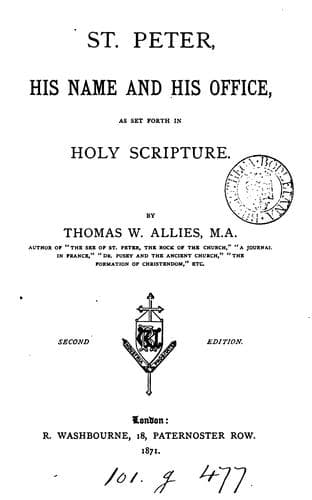
St. Peter, His Name and His Office, as Set Forth in Holy ScriptureAllies, T. W. (Thomas William)
Religion
St. Peter, His Name and His Office, as Set Forth in Holy Scripture
Allies, T. W. (Thomas William)
Peter, the Apostle, Saint
For indeed Christ is the Saviour, but of His mystical body,
which[66] is the Church, which therefore He purchased with His own
blood, joined to Himself by that closest bond of being His spouse,
enriched with promises,[67] provided with all manner of graces, and
most nobly dowered with[68] truth, charity, and the Holy Spirit, to
give her at last salvation, and[69] "the weight of eternal glory."
But have these things reference to a visible or an invisible Church?
To a Church one and coherent, or rent and torn by factions? It is
the Church which Christ founded, which He made to be[70] "the light
of the world," bound together by[71] manifold external links,
ordered to be one with the unity of a house, a family, a city, a
kingdom; with that unity wherewith the Father and the Son are one;
in which He placed[72] pastors and doctors to bind and to loose, and
to watch over the agreement of all the parts; which He founded upon
Peter, committed in chief to Peter to rule and to feed it. Such,
then, as fall off from one single visible Church are of the
condition of those whom the Apostles of the Lord foretold, that "in
the last time there should come mockers, walking according to their
own desires in ungodlinesses: these are they who separate
themselves, sensual men, having not the[73] Spirit:" these tear
themselves from their Saviour, lose the fruit purchased by His
blood, and fall from the inheritance which the Head obtained for His
body and His members.
Therefore the necessity of union with the one single visible Church
is as great as the necessity of union with Christ the Head, as the
necessity of the remission of sins, "for[74] outside of it they are
not remitted: for this Church has specially received the Holy Spirit
in earnest, without whom no sins are remitted:" as the necessity of
charity, "[75]for it is this very charity which those who are cut
off from the communion of the Catholic Church do not possess,"
whence "[76]whatsoever thing heretics and schismatics receive, the
charity which covers a multitude of sins is the gift of Catholic
unity and peace:" as great, in fine, as the necessity not to involve
oneself "in[77] a horrible crime and sacrilege," "in[78] the
greatest of evils," one "by[79] which Christ's passion is rendered
of no effect, and His body is rent," by which[80] the sin is
committed of which Christ said, "It shall not be forgiven, neither
in this world nor in the world to come:" by which one is estranged
"from the sole Catholic Church, which retains the true worship, in
which is the fountain of truth, the home of faith, the temple of
God, into which if any one enter not, or from which if any one go
out, he loses the hope of life and eternal salvation. Let no one
flatter himself in the spirit of obstinate contention, for life is
at issue, and salvation, which without care and caution will be
forfeited."[81] Can any necessity be greater, or less conditional
than this? Or what can be more plain than this statement of the
Public-domain text, read in full here on John Shaqi.
Reviews
Reviews
No reviews yet
Be the first to share your thoughts on this work.
Elsewhere in the archive
Join the Discussion
Join the discussion
Sign in to leave a comment or review.
Sign InorCreate an account