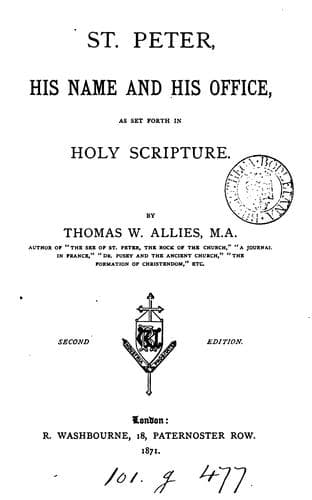
St. Peter, His Name and His Office, as Set Forth in Holy ScriptureAllies, T. W. (Thomas William)
Religion
St. Peter, His Name and His Office, as Set Forth in Holy Scripture
Allies, T. W. (Thomas William)
Peter, the Apostle, Saint
simple and absolute necessity of visible unity and outward
communion?
Where then are we to find the cause which induced so many learned
and able Protestants first to imagine this distinction between the
necessity of internal and external communion and unity, and then to
deceive themselves and others with such a mockery? The real cause
was, as I believe, that having denied the institution of the
Primacy, and the authority lodged in it for the purpose of forming
and maintaining unity, they were without a criterion or proof, in
virtue of which, among so many Christian societies divided from and
condemning each other, they could safely choose the one with which
they were to be joined in communion, and the outward unity of duty
and obedience. For they would readily conclude that the unity so
often commended in Scripture, and so earnestly enjoined, could not
be external, since God, who does not command impossibilities, had
instituted no visible sign to mark that company of Christians, which
alone among all the rest was the continuation and development of the
Church founded by Christ, and built up by the Apostles.
C. From the same source must the third Protestant doctrine on unity
be derived. [82]Jurien filled up the sketch of this, which
[83]Casaubon, [84]Claude, and [85]Mestrezat had drawn, and it became
so popular as not only to infect a large number of Protestants, but
to exert a withering influence on certain unstable members of the
Catholic body. It teaches that we must believe not only in an
internal and spiritual, but in a visible and external unity, for the
Scriptures plainly urge its necessity, and Christian tradition fully
describes it, so that there is not a truth more patent or
established on greater authority; but this unity is restricted
within narrow bounds, and confined to the articles called
fundamental, though as to how many these are no one defender of the
system is agreed with another. For it is sufficient for Christians
not to differ in the profession of such articles for them to be
deemed members of one and the same Church. Whence they infer that
one and the same true Church is made up out of almost all Christian
societies, the Roman, the Greek, the Nestorian, the Eutychian, the
Waldensian, the Lutheran, the Anglican, and the Calvinist, for their
differences, important as they are, offer no hindrance to the unity
which Christ enjoined, the Apostles preached, the creeds express,
and universal tradition demands.
As Bossuet,[86] the brothers Walemburg,[87] Nicole,[88] and even
some Protestants have most fully dealt with this portentous opinion,
there is no need to urge much against it here. I prefer repeating
the question, what _occasion_ the Protestants had to get up so
unheard-of a paradox, and a system so absurd? It was twofold: one
theoretical, and the other practical.
Public-domain text, read in full here on John Shaqi.
Reviews
Reviews
No reviews yet
Be the first to share your thoughts on this work.
Elsewhere in the archive
Join the Discussion
Join the discussion
Sign in to leave a comment or review.
Sign InorCreate an account