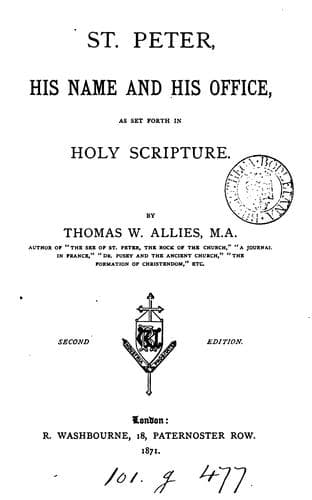
St. Peter, His Name and His Office, as Set Forth in Holy ScriptureAllies, T. W. (Thomas William)
Religion
St. Peter, His Name and His Office, as Set Forth in Holy Scripture
Allies, T. W. (Thomas William)
Peter, the Apostle, Saint
The theoretical was this. The crime of heresy, depicted in
Scripture, and Christian antiquity, with colours so dark, had
gradually lost its foulness and its magnitude in the minds of
Protestants, who had, at length, come to the pass of reckoning
religious, as well as civil, liberty, among the unquestionable
rights of man. As if, all other human acts being subject to a law,
those alone which proceed from the intellect are exempt: as if the
difference between right and wrong, which embraces the whole range
of man's life, did not relate to its noblest part, in the acts of
the intellect and the reason: as if God had laid down a law of
justice, charity, fortitude, and prudence, but entirely omitted a
_law[89] of faith_: as if the will submitted to a law of _good_, but
the mind owned no law of _truth_: or as if God cared for the boughs
and leaves, but took no thought of the root.[90] But what could
Protestants do? Having allowed to all full license of thought, and
overthrown the authority which ruled the mind, they were forced,
while they kept the _name_ of heresy, to give up the _thing_ meant
by it, and the effects springing from that thing: they were forced
to attenuate to the utmost the crime of heresy, and to reduce to the
smallest possible number the articles necessary to be believed by
all; they were forced to extend beyond all measure the Church's
limits, while they contracted beyond all measure the range of
necessary unity.
Besides the theoretical, there was a practical occasion in those
schisms which, not merely in later or in mediaeval times, but in the
first ages also, rent the Christian society. Jurien and Pfaff appeal
to these, pretentiously enumerating those which arose under Popes
Victor, Cornelius, Stephen, Urban VI., and Clement VII., and those
named from Donatus, Meletius, and Acacius. Then they ask if the true
Church of Christ can be thought to consist in one single society
perfectly at union with itself. They allege many conjectures against
this, but dwell on the argument, that _in defect of a visible
external test_, such an assertion could not be maintained without
_imposing upon all a most intolerable burden of searching out where
is the true doctrine and the legitimate ministerial succession_: for
it is not until those are found, that, at length, that one single
society will be recognised, with which, as the only true Church,
unity of Communion is to be kept.
Public-domain text, read in full here on John Shaqi.
Reviews
Reviews
No reviews yet
Be the first to share your thoughts on this work.
Elsewhere in the archive
Join the Discussion
Join the discussion
Sign in to leave a comment or review.
Sign InorCreate an account