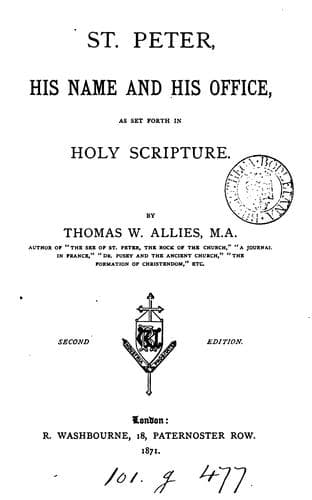
St. Peter, His Name and His Office, as Set Forth in Holy ScriptureAllies, T. W. (Thomas William)
Religion
St. Peter, His Name and His Office, as Set Forth in Holy Scripture
Allies, T. W. (Thomas William)
Peter, the Apostle, Saint
Now, two points are signified in it, one of which is its _material_,
the other its _formal_, or _essential_, part. Its _material_ part
is, that the geographical extension of the true Church be such that
its mass be _morally_[98] universal, _absolutely_ great, and
eminently visible, but _comparatively_ with all heretical and
schismatical sects, larger and more numerous. Of this _material_
meaning attached to the epithet, Catholic, we find abundant
witnesses in all[99] the orthodox writers who defended the cause of
the Church against the Donatists, and again, against the
Luciferians,[100] and Novatians; and likewise, in those who have
explained the creeds,[101] and, as occasion offered, have touched on
the force of the term Catholic.[102] But the same first cited
witnesses tell us that universal diffusion is not sufficient, and
that we require another element to infuse a soul into this
universally extended body, and to bring it to unity.
For two properties are continually recurring in Christian records, one
of which may be called _negative_, the other _affirmative_. The force
of the former is to _expel from the circle of the one true Catholic
Church all sects of heretics and Schismatics_: of the latter, that
this Church _consist in one single communion and society, whose
members cohere together by hierarchical subordination_.
But is it true that both these points are so plainly and constantly
inculcated? To remove all doubt we will quote the authors who most
distinctly assert the one and the other. As to the first, there are
[103]Clement of Alexandria, [104]Tertullian, [105]Alexander of
Alexandria, [106]Celestine, [107]Leander, the Emperor Justinian;[108]
then again the Councils of Nice,[109] Sardica,[110] and the
third of [111]Carthage; nay, the heretics[112] themselves; and all
these agree in asserting that _there is one only ancient Catholic
Church_, outside of which the divine patience endures and bears with
heresies, which are as thorns. Thus in language ecclesiastical and
Christian nothing can be considered as more certainly proved than
that the epithet of Catholic is _distinctive_, and shows the
communion which rejects from its bosom all heresies and all schisms.
It was with great reason, therefore, that [113]Pacian wrote what
[114]Cyril of Jerusalem, and [115]Augustine very frequently
repeated, "Our people is divided from the heretical name by this
appellation, that it is called Catholic."
Public-domain text, read in full here on John Shaqi.
Reviews
Reviews
No reviews yet
Be the first to share your thoughts on this work.
Elsewhere in the archive
Join the Discussion
Join the discussion
Sign in to leave a comment or review.
Sign InorCreate an account