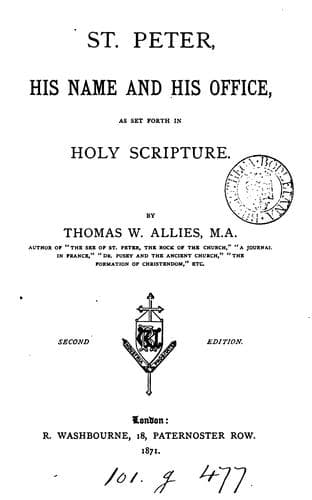
St. Peter, His Name and His Office, as Set Forth in Holy ScriptureAllies, T. W. (Thomas William)
Religion
St. Peter, His Name and His Office, as Set Forth in Holy Scripture
Allies, T. W. (Thomas William)
Peter, the Apostle, Saint
Moreover this unity, which we have said may be called _negative_, is
necessary indeed to the understanding of the Church as Catholic, but
is by no means sufficient to complete the idea of Catholicity. To it
therefore must be added the _affirmative_ unity, by which
Catholicism is not only divided from heretics and schismatics, but
becomes in itself a coherent body with members and articulations. It
is to the assertion and maintenance of this unity, which is the soul
of Catholicity, and without which it cannot even be conceived, that
has reference what we so often read in the monuments of antiquity
about the [116]necessity of communion among the members of the
Church and the [117]tokens and means of that communion. There are
very distinct and innumerable testimonies about it in the ancient
Fathers,[118] declaring its _necessity_, and setting forth its
_mode_ of composition and coherence.
For to set forth the _mode_ of this is the plain drift of what
[119]Irenaeus writes in confutation of heretics by the tradition of
the Apostolical churches: "For since it would be very long in the
compass of our present work to enumerate the successions of all the
Churches, taking that Church which is the greatest, the most
ancient, and well known to all, founded and established at Rome by
the two most glorious Apostles, Peter and Paul, by indicating that
tradition which it has from the Apostles, and the faith which it
announces to men, which has reached even to us by the succession of
bishops, we confound all those, who, in whatsoever manner, either
through self-pleasing, or vain glory, or blindness and evil
intention, [120]gather otherwise than they ought. _For_ to this
church on account of its superior chiefship, it is necessary that
every Church should come[121] together, that is, the faithful who
are everywhere; for in this Church the tradition which is from the
Apostles has been ever preserved by those who are everywhere.
...By this ordination and succession, the tradition and preaching of the
truth, which is from the Apostles in the Church, has reached down to
us. And this proof is most complete, that it is one and the same
vivifying faith, which has been preserved, and handed down in truth,
in the Church from the Apostles to the present day."
The churches, therefore, which are everywhere diffused, derive that
strength and harmony of parts, out of which the whole body of the
Catholic Church is made up, from the fact of their agreeing in the
unity of faith and preaching with that Church of Peter, which is the
greatest, the chief, and the more powerful. It follows that the
Primacy of Peter, and the authority inherent in it to effect unity,
is that principle which Christ selected, that the Church which He
had set up might be Catholic, and bear the note of Catholicity on
its brow.
Public-domain text, read in full here on John Shaqi.
Reviews
Reviews
No reviews yet
Be the first to share your thoughts on this work.
Elsewhere in the archive
Join the Discussion
Join the discussion
Sign in to leave a comment or review.
Sign InorCreate an account