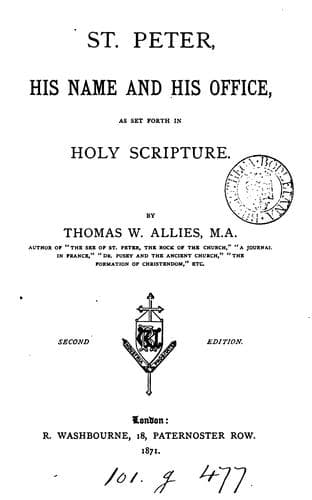
St. Peter, His Name and His Office, as Set Forth in Holy ScriptureAllies, T. W. (Thomas William)
Religion
St. Peter, His Name and His Office, as Set Forth in Holy Scripture
Allies, T. W. (Thomas William)
Peter, the Apostle, Saint
[120] Compare Jerome's often-quoted passage, Ep. 15, to Pope
Damasus, "Whoso gathereth not with thee, scattereth; that is, whoso
is not of Christ is of antichrist."
[121] For the meaning of "come together," see farther on, c. 40.
"God hath placed in the Church Apostles, Prophets, Doctors, and all
the rest of the operation of the Spirit, of which all those are not
partakers who do not _run together to the Church_, but defraud
themselves of life by an evil intention and a very bad conduct. For
where the Church is, there is the Spirit; and where is the Spirit of
God, there is the Church and all grace."
[122] See S. Cyprian's letters, 69, 55, 45, 70, 73. 40. Consider the
force of the words, "Peter, upon whom the Church had been built by
the Lord, speaking one for all, and _answering with the voice of the
Church_, says, Lord, to whom shall we go?" Ep. 55, on which Fenelon
(de sum. Pontif. auct. c. 12) remarks, "What wonder, then, if Pope
Hormisdas and other ancient fathers says, "the Roman, that is, the
Catholic Church," since Peter was wont to answer _with the voice of
the Church_? What wonder if the body of the Church speaks by mouth
of its head?"
[123] De Pudicitia, c. 21.
[124] This Montanist corruption (into which Ambrose on Ps. 38, n.
37, and Pacian in his three letters to Sempronian, state that the
Novatians also fell,) induced some fathers, and especially
Augustine, (Enarrat. on Ps. 108. n. 1, Tract 118 on John, n. 4, and
last Tract n. 7) to teach that the keys were bestowed on Peter so
far forth as he represented the person of the Church in right of his
Primacy. By which mode of speaking they meant this one thing, that
the power of the keys, as being necessary to the Church, and
instituted for her good, began indeed in Peter, and was communicated
to him in a peculiar manner but by no means dropt, or could possibly
drop, with him.
[125] Tertull. De Praesc. c. 32.
[126] Pacian, ad Sempronium, Epis. 3, Sec. 11.
[127] Ambrose, de Poenit. Lib. 1, c. 7, n. 33.
[128] Synodical Epistle, among the letters of Ambrose.
[129] Optatus, de Schism. Donat. Lib. 2, c. 2, and Lib. 7, c. 3.
[130] Gregory, de vita sua, Tom. 2, p. 9.
[131] Jerome, adv. Jovin. Lib. 1, n. 14.
[132] Augustine, in Ps. Cont. partem Donati, cont. Epist. Fundam. c.
4, de utilitate credendi, c. 17, and Epist. 43.
[133] Gelasius, Epis. 14.
[134] Hormisdas, Mansi, Tom. 8, 451, in the conditions on which he
readmitted the Patriarch of Constantinople and the Eastern bishops
to communion.
[135] Agatho, in a letter to the sixth council, read and accepted at
its fourth sitting.
[136] Maximus, Bibl. Patr. Tom. 11, p. 76.
[137] Leo, Epist. 10, c. 1.
[138] Ep. 358, to Pope Celestine.
[139] The above chapter is translated from Passaglia, Pp. 298-336.
CHAPTER IX.
THE NATURE, MULTIPLICITY, AND FORCE OF PROOF FOR S. PETER'S
PRIMACY.
Public-domain text, read in full here on John Shaqi.
Reviews
Reviews
No reviews yet
Be the first to share your thoughts on this work.
Elsewhere in the archive
Join the Discussion
Join the discussion
Sign in to leave a comment or review.
Sign InorCreate an account