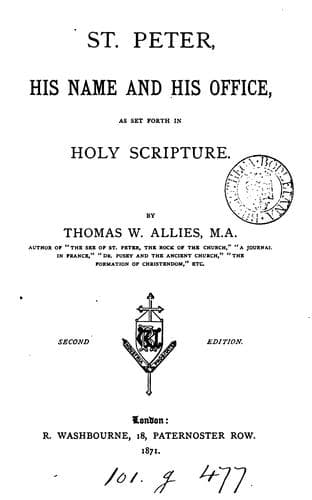
St. Peter, His Name and His Office, as Set Forth in Holy ScriptureAllies, T. W. (Thomas William)
Religion
St. Peter, His Name and His Office, as Set Forth in Holy Scripture
Allies, T. W. (Thomas William)
Peter, the Apostle, Saint
[1]As the natural end of all proof is to give assurance, every kind
of it must be considered a mean to persuade and determine the mind.
Not but that there are different kinds, and that in great variety. If
we refer these to their respective topics, some are _internal_ and
_artificial_, others _external_ and _inartificial_; some belong to
the philosopher, others to the theologian, the former having their
source in nature, the latter in revelation; another sort, again, rests
on _witnesses_, and another on _documents_. But if we consider
their persuasive force, they may be conveniently ranged under the
two classes of _probable_, and _certain_ or _demonstrative_.
But if it be asked what sort of proof we have hitherto used, and
drawn out to the best of our ability, we must distinguish between
the _principal_ and prevailing proof, and this in form is
inartificial, theological, and drawn from the inspired documents;
and the proofs _occasionally inserted_ and confirmatory of the
principal: these, it will be evident, are sometimes artificial and
internal, such as those drawn from analogy, and the harmonious
coherence of doctrines, from the unity and Catholicity of the
Church, and the institution of bishops to rule particular flocks;
and sometimes derived from witnesses, for such we may deem the
ancient Fathers, whose importance and force, as testimonies, no
prudent mind will reject. To embrace, then, the full extent of our
proof, it ranges over all forms and modes, is artificial and
inartificial, and rests not only on documents, but on witnesses. Now
two things follow from this mixed and manifold character of our
proof, of too great importance to be passed over in silence.
The first of these is, the standard and criterion of resistance
which our proof presents to opponents. For consisting, as it does,
of so many elements, confirmed, as it is, by the absolute harmony of
so many various parts, that only can be a satisfactory answer, which
meets at once every particular proof, and the whole sum of it. For
it would be to small purpose to give another sense, with some
speciousness, to one or two points, if the great mass of matter and
argument remain untouched. The only valid answer would be _to reject
and deny the Primacy of supreme authority, presenting at the same
time a sufficient cause for all those results of which the proof
consists_. For so long as the institution of the Primacy is
necessary to supply a sufficient cause for these results, so long
the force of our proof remains untouched, and the institution of the
Primacy unquestionable. We can therefore demand of our opponents
this alternative, either to acquiesce in our proof, or, rejecting
the Primacy, to find, and when they have found to establish, an
hypothesis equal to the explanation of all that is contained in our
arguments artificial and inartificial, in our documents and our
witnesses.
Public-domain text, read in full here on John Shaqi.
Reviews
Reviews
No reviews yet
Be the first to share your thoughts on this work.
Elsewhere in the archive
Join the Discussion
Join the discussion
Sign in to leave a comment or review.
Sign InorCreate an account