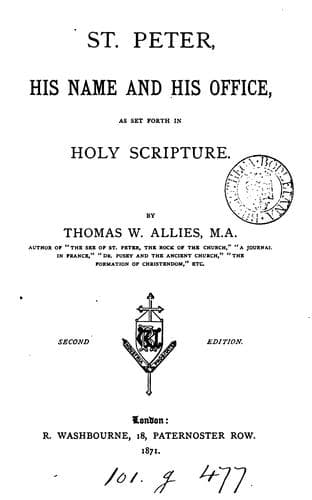
St. Peter, His Name and His Office, as Set Forth in Holy ScriptureAllies, T. W. (Thomas William)
Religion
St. Peter, His Name and His Office, as Set Forth in Holy Scripture
Allies, T. W. (Thomas William)
Peter, the Apostle, Saint
allow of appeal from its sentence, but rather require obedience to
its decrees."[11] And Pope Agatho, in the Roman Council, pronouncing
on the appeal of our own S. Wilfrid, of York, the contemporary of
Bede, A.D. 688, declares that "Wilfrid the bishop, beloved of God,
knowing himself unjustly deposed from his bishopric, did not
_contumaciously resist by means of the secular power_, but with
humility of mind sought the canonical aid of our founder, blessed
Peter, prince of the Apostles, and declared in his supplication that
he would accept what by our mouth, blessed Peter, our founder, whose
office we discharge, should determine."[12] 9. _The history of the
ecclesiastical hierarchy_,[13] and of the _rights possessed by
certain episcopal Sees over others_, of which we may take an
instance in the grants of Pope Gregory the Great, and his
successors, to the See of Canterbury, which alone made it a Primacy.
For the bishops of Canterbury had no power whatever over the other
bishops of this country, save what they derived from S. Peter's See.
And the documents, and original letters conferring these powers
still exist, giving the fullest proof that Pope Pius only did in
1850, what Pope Gregory did in 596. 10. _The history of the
universal propagation of the Christian religion._[14] 11. _The
history of those tokens and pledges_,[15] such as letters of
communion, whereby Catholic unity was exhibited and maintained. 12.
_The history of Christian archaeology_,[16] inscriptions, paintings,
and other monuments of this kind. 13. _The history of the emperors_,
as, for instance, what Ammianus Marcellinus[17] says of Constantius;
the letter of the Emperor Marcian to Pope Leo, entreating him to
confirm the council of Chalcedon; that of Galla Placidia, the 130th
novel of Justinian, and the remarkable constitution of Valentinian
III., A.D. 445. "Since the merit of S. Peter, who is the chief of
the episcopal coronet, and the dignity of the Roman city, moreover,
the authority of a sacred synod" (that of Sardica, A.D. 347) "have
confirmed the Primacy of the Apostolic See, let presumption not
endeavour to attempt anything unlawful, contrary to the authority of
that See: for, then, at length, the peace of the Church will
everywhere be preserved, if the whole (universitas) acknowledge its
ruler." And, 14. lastly, _the history of codes_, in which is
contained the legislation of Christian kingdoms, wherein we may
refer to the capitulars of the Franks, and the laws of the Lombards.
Public-domain text, read in full here on John Shaqi.
Reviews
Reviews
No reviews yet
Be the first to share your thoughts on this work.
Elsewhere in the archive
Join the Discussion
Join the discussion
Sign in to leave a comment or review.
Sign InorCreate an account