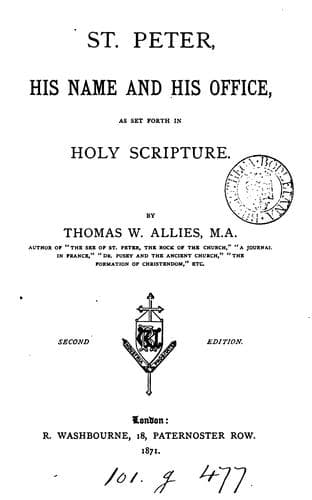
St. Peter, His Name and His Office, as Set Forth in Holy ScriptureAllies, T. W. (Thomas William)
Religion
St. Peter, His Name and His Office, as Set Forth in Holy Scripture
Allies, T. W. (Thomas William)
Peter, the Apostle, Saint
Now from these concordant proofs thus slightly sketched, it follows
that the institution of the Primacy belongs to that class of facts
which is most certain, and which is absolutely demonstrated. For
would it be possible to find a concurrence of proofs so various in
case it had never been instituted? Is it possible to imagine so many
various results of a cause which never existed? So many various
tokens of reality in a fiction? What are the chances for letters
thrown at random forming themselves into an eloquent speech? Or a
beautiful portrait coming out from a mere assemblage of colours? Or
a whole discourse in an unknown tongue being elegantly rendered by a
guess? If these be sheer absurdities, although a few letters have
sometimes tumbled at random into a word, or a single clause been
decyphered, though in ignorance of the alphabet, then we may be sure
that the Primacy, attested by so vast a variety of convergent
results, can no more be untrue, than effects can exist without a
cause, splendour without light, or vocal harmony without sound.
Accordingly an institution established by such a union of proof,
carries prisoner the assent. It may indeed be disregarded by a
resolution of the _will_, but can neither be passed by, nor refuted,
by a judgment of the _reason_.
And[18] having on the one hand this vast amount of _positive_
proof, from sources so various, in its behalf, so that without it
the whole Christian history of eighteen centuries, in all its
manifold blendings with secular history, becomes unintelligible, a
snarl which it is impossible to arrange, when we come on the other
hand to consider what its opponents allege of _positive_ on their
own side, we find nothing. They content themselves with objections
to this or that detached point, with historical difficulties, and
obscurations of the full proof, such, for instance, as the conduct
of S. Cyprian in one controversy, the occasional resistance of a
metropolitan, the secular instinct of an imperial government
stirring up eastern bishops to revolt, and fostering an Erastian
spirit in the Church, the ambition of thoroughly bad men, such as
Acacius or Photius, and the like. But what we may fairly ask of
opponents, and what we never find the most distant approach to in
them is, if, as they say, S. Peter's Primacy be not legitimate, and
instituted by Christ for the government of the Church, what _counter
system_ have they, which they can prove by ancient documents, and
whereby they can solve the manifold facts of history? In all their
arguments against the Primacy they are so absolutely _negative_,
that the grand result, if they were successful, would be to reduce
the Church to a heap of ruins, to show that she, who is entrusted
with the authoritative teaching of the world, has no internal
coherence either of government or doctrine, in fact, no message from
God to deliver, and no power to enforce it when delivered. In the
Public-domain text, read in full here on John Shaqi.
Reviews
Reviews
No reviews yet
Be the first to share your thoughts on this work.
Elsewhere in the archive
Join the Discussion
Join the discussion
Sign in to leave a comment or review.
Sign InorCreate an account