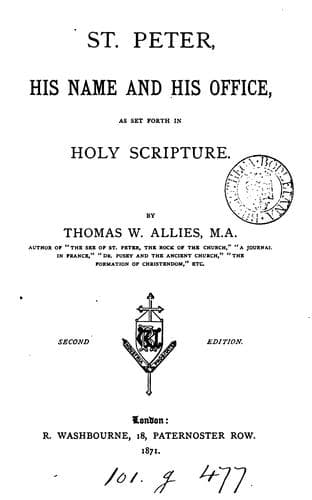
St. Peter, His Name and His Office, as Set Forth in Holy ScriptureAllies, T. W. (Thomas William)
Religion
St. Peter, His Name and His Office, as Set Forth in Holy Scripture
Allies, T. W. (Thomas William)
Peter, the Apostle, Saint
I. Now, to begin with _words_, I shall not be severe, but allow to
Anglicans, Lutherans, and Calvinists, that the texts alleged by each
of them in behalf of his own cause consist of words which are either
immediately perspicuous, or become mediately clear upon definite
principles. But in turn I should ask them repeatedly to consider
whether such a perspicuity can be denied to the words of which the
texts cited for the Primacy of Peter consist. These words are in
general and vulgar use, continually repeated in the Bible, but so
connected together that their certain meaning is either immediately
evident, or fixed with very little trouble. But are not most of them
metaphorical, such as _rock_, _building_, _keys_, _binding_,
_loosing_, _lambs_, _sheep_, _feeding_? Undoubtedly some are such,
yet not that words used in their _proper_ sense are wanting, as when
Peter is called _the first_, _the greater_, the _superior_; also
when he is charged _to confirm his brethren_; and what we collect
from the Acts of the Apostles, the Epistles of S. Paul, and the
evangelists' mode of writing. Not, _secondly_, that it is not
evident, from the connection of the discourse, what fixed and
established meaning must be given to those metaphorical expressions.
Not, thirdly, that the meaning of those formulas is not shown by the
exercise of the powers conferred in them. Not, fourthly, that there
is any inability, if you remove the metaphor, to express in _proper_
words what the metaphor shadows out. Not, fifthly, as if the literal
and immediate sense were therefore wanting; for it is very plain
that the metaphorical[25] sense likewise is literal and immediate.
And sixthly, not that _metaphorical_ can be considered equivalent to
_obscure_, for obscurity is most opposed to the very genius of
metaphor, and such a canon would destroy the perspicuity of human
language. For there is no language, ancient or modern, rude or
polished, semitic, chamitic, or japhetic, whose _metaphorical_ is
not much more copious than its _proper_ vocabulary.
Public-domain text, read in full here on John Shaqi.
Reviews
Reviews
No reviews yet
Be the first to share your thoughts on this work.
Elsewhere in the archive
Join the Discussion
Join the discussion
Sign in to leave a comment or review.
Sign InorCreate an account