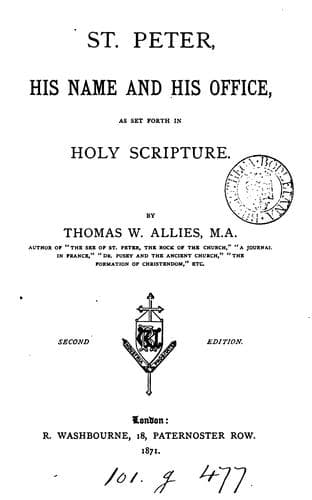
St. Peter, His Name and His Office, as Set Forth in Holy ScriptureAllies, T. W. (Thomas William)
Religion
St. Peter, His Name and His Office, as Set Forth in Holy Scripture
Allies, T. W. (Thomas William)
Peter, the Apostle, Saint
Metaphor, then, and obscurity are very far removed from each other,
and there is nothing to prevent a metaphorical expression bearing
the plainest sense. For such the sense will be, whenever what is
called the _foundation_ of the metaphor is clear, and the series of
the discourse indicates _the point of likeness_, and usage of speech
unfolds _the force_ of the metaphor. Now all these conditions, which
ensure perspicuity in the metaphor, are found in interpreting the
metaphors which contain the singular prerogatives of Peter. For as
it is perfectly plain whence the metaphors of _foundation_,
_building_, _keys_, _binding_, _loosing_, _sheep_, _lambs_,
_shepherd_, are drawn, so the context defines the point of
similitude, and usage of speech does not allow ignorance of the
force of such metaphors. And thus the texts on Peter's Primacy have
a verbal perspicuity which will bear a favourable comparison with
those texts, on which Anglicans, Lutherans, and Calvinists rely. For
indeed all the difficulties, in the invention of which Protestants
have shown their ingenuity, are introduced, put upon the words, not
drawn from them. So on the contrary, the haters of the Primacy
evidently wince at their clearness.
2. _Verbal_ perspicuity is followed by _real_, or that which concerns
the _subject matter_. And this, I assert, is far inferior, far more
slender, in the above named Protestant controversies, than in this
of the Catholics. Indeed, both the controversies, on the real
presence and on the divinity of Christ, have a super-intelligible
object, so far exceeding the natural power of reason, as to admit
of the mind's conceiving it by analogy, but not by a _distinct_ and
_proper_ knowledge. For this is the nature of mysteries, whence it
follows in them that neither single words have distinct notions,
nor a whole proposition distinct sense. Whereas in the controversy
about the Primacy, there is nothing which is not commensurate with
reason, and which has not the advantage of proper and distinct
notions. For, of revealed truths, some being _rational_, some
_beyond_ reason, and some _above_ reason, the proper character of
those which are called _beyond_ reason is, that, _if_ revealed, they
are cognizable by reason. Now to such an order of truths the
institution of the Primacy belongs. Thus its _real_ evidence, that
namely which concerns its _subject matter_, is much superior to that
which the others admit of. But should we grant as much to the
controversy in which Anglicans defend the superiority of bishops
over presbyters? Grant this, yet still it remains that in this
species of _real_ evidence the cause of the Primacy is far superior
to that of the real presence, or that of the divinity of Christ.
But, in truth, the Anglican doctrine on bishops may be considered
from two points of view, either as severed from the Catholic dogma
on Peter's Primacy, or as in connexion and coherence with it. From
the latter point of view I should admit it to be so agreeable to
Public-domain text, read in full here on John Shaqi.
Reviews
Reviews
No reviews yet
Be the first to share your thoughts on this work.
Elsewhere in the archive
Join the Discussion
Join the discussion
Sign in to leave a comment or review.
Sign InorCreate an account