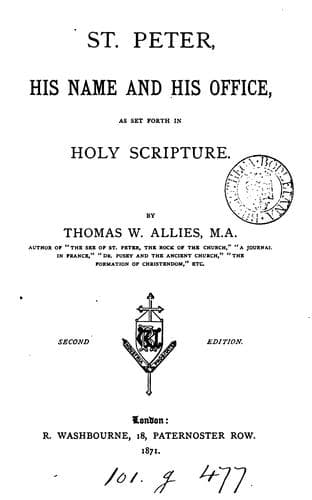
St. Peter, His Name and His Office, as Set Forth in Holy ScriptureAllies, T. W. (Thomas William)
Religion
St. Peter, His Name and His Office, as Set Forth in Holy Scripture
Allies, T. W. (Thomas William)
Peter, the Apostle, Saint
tolerated by the impatience of a population, which has little time
and less mind for studies of this character. I have pursued,
therefore, the humble task of _popularising_, so far as I could,
Father Passaglia's work, omitting, as I trust, no essential part of
the argument, and grouping it under different combinations, each of
which might be in turn presented to the eye, and so more readily
embraced.
The importance of the argument, as it affects the Papal Supremacy,
which is but a summary of the whole cause at issue between
Protestantism in every shape, and the Church of Christ, cannot be
overrated. If St. Peter be already set forth in Scripture as the
Head and Bond of the Apostolic College, if he be delineated as the
supreme Ruler who succeeds our Lord Himself in the visible
government of His Church on earth, there becomes at once the
strongest ground for expecting that such a Ruler will be continued
as long as the Church herself lasts. Thus a guiding clue is given to
us among all the following records of antiquity. Tradition and
history become illuminated with a light which exhibits all objects
in their due proportion and true grouping, when they are shown to be
but the realisation of what the Incarnate Word, His Church's one
only Lawgiver, decreed from the beginning, set forth not only in
prophetic image, but distinct command, and stored up in words of
such exceeding power, that they bear the whole weight of the kingdom
of God, stretching through all ages and nations, without effort or
pressure. And if ancient writers speak in no doubtful tone of St.
Peter's prerogatives, yet clearer, more emphatic, and soul-piercing,
as we should expect, are the words of God Himself, appealing in
man's form to the mind and heart of man, whom He had created, and
was come to redeem, and to knit into one eternal monarchy.
A subsequent part of the argument, namely, that the Bishop of Rome
_is_ successor of St. Peter, has been treated by the author in
another work, "The See of St. Peter the Rock of the Church, the
Source of Jurisdiction, and the Centre of Unity," specially in the
fifth section, which ought, logically, to be preceded by this
treatise. It is there proved that not only the Christian Fathers, as
individual writers and witnesses, but the ancient Church in her
universal Councils, did, with one voice, from age to age, regard the
Pope as sitting in St. Peter's chair, which is proof enough, and all
that can in reason be demanded, that the prerogatives given to St
Peter as Head of the Church were, in the belief of the Church, and
in full accordance with our Lord's own promise,[A] continued on to
his successors, and are as imperishable as the life of the Church
herself.
21, North Bank, Regent's Park,
September, 1852.
FOOTNOTES:
[A] Matt. xvi. 18.--"Thou art Peter, and upon this rock I will build
my Church, and the gates of hell shall not prevail against it," _i.
e._, as founded on that rock. The foundation and the superstructure
coexist for ever.
Public-domain text, read in full here on John Shaqi.
Reviews
Reviews
No reviews yet
Be the first to share your thoughts on this work.
Join the Discussion
Join the discussion
Sign in to leave a comment or review.
Sign InorCreate an account