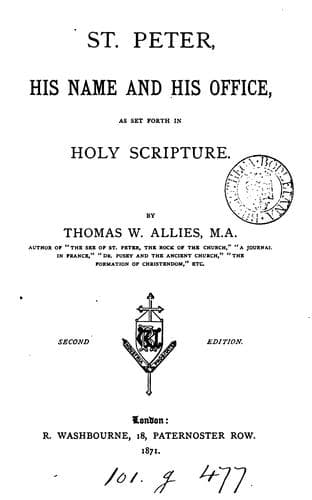
St. Peter, His Name and His Office, as Set Forth in Holy ScriptureAllies, T. W. (Thomas William)
Religion
St. Peter, His Name and His Office, as Set Forth in Holy Scripture
Allies, T. W. (Thomas William)
Peter, the Apostle, Saint
And this argument might be carried much further, if they would
reflect how great is the brilliancy of evidence in behalf of the
Primacy, compared with sundry other capital Christian doctrines,
some or all of which they hold without question: such are the
consubstantiality of the Trinity, the unity of Christ's Person, the
propagation of original sin, the eternity of punishment,
regeneration in baptism, and gratuitous justification. They will
find, on reflection, that they hold these doctrines not because they
are proved by stronger scriptural evidence than the Primacy, for
quite the reverse is the truth, nor because they are encompassed
with less obscurity in their own character, for the subject matter
of the Primacy is clear and distinct in comparison with them all,
but because the doctrines do not oppose the particular tradition
which they have received, and so their minds are not set against
them. Let them once come to compare the whole evidence for the
Primacy, scriptural, traditional, analogical, and historical, which
last alone comprehends the fourteen heads above enumerated, with the
same evidence in behalf of any or all of those, and they cannot but
admit its great superiority.
3. But we must proceed to the _third_ criterion, which increases not
a little the evidence from revelation for the Primacy. For Catholics
and Protestants are agreed in considering _analogy_ as one of the
best helps in interpretation, and in assigning to it the force of a
real parallelism, a proceeding which rests on the necessity of the
Scripture presenting one whole and harmonious body of doctrine in
its several parts. And in order not to deprive this help of its
efficacy, both parties give two conditions for its exercise, the
first, _that no sense be put upon passages of Scripture contrary to
analogy_; the second, _that no violence be used to the language of
Scripture to conform it with analogy, which would be imposing on
holy writ the sense wanted from it_. These two faults carefully
avoided, analogy is of great service, and throws much light upon
interpretation.
Public-domain text, read in full here on John Shaqi.
Reviews
Reviews
No reviews yet
Be the first to share your thoughts on this work.
Elsewhere in the archive
Join the Discussion
Join the discussion
Sign in to leave a comment or review.
Sign InorCreate an account