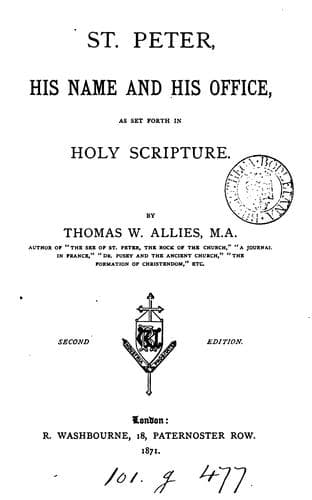
St. Peter, His Name and His Office, as Set Forth in Holy ScriptureAllies, T. W. (Thomas William)
Religion
St. Peter, His Name and His Office, as Set Forth in Holy Scripture
Allies, T. W. (Thomas William)
Peter, the Apostle, Saint
But, now, is there such a sum of doctrine, so remarkable, and so
diffused through all the books of the New Testament, that the texts
expressing the gifts and prerogatives of Peter, can be tried by the
touchstone of this analogy? Such, indeed, there is, very remarkable,
and threefold in character. The first point is found in the
texts[26] which regard the divine institution of bishops: the other
two in those which show the unity,[27] and the Catholicity[28] of
the Church. For what can stand in closer connection with these
articles of doctrine, than the appointment of a supreme ruler to
discharge over the universal Church the office which every bishop
exercises over his own particular Church, and his own portion of the
flock? What, again, can be more opposed to them, than the
supposition that provision was made, by the institution of bishops,
for _the parts_, but none, by the institution of a supreme pastor,
for _the whole body_, which is to be one and Catholic? Therefore,
that exposition of the texts concerning Peter, which exhibits him as
ruler of the Church universal, and as made to be the visible cause
of that same Catholic unity, so admirably agrees with analogy, that
it must be considered unquestionable, unless texts contradictory to
it can be produced. But so far is it from the case that texts
_considered in themselves_ contradict it, that, on the contrary,
they _immediately_ express it _of themselves_, and can be distorted
from it only by violating all the laws of interpretation. Accordingly,
that view of the texts about Peter, which establishes his Primacy,
is wonderfully confirmed by analogy, and by its harmony with what
the Scriptures tell us of the Church, as instituted by Christ.
4. And nothing will be wanting to give full assurance to this
confirmation, if we add the _fourth or external_ criterion, that
derived from consent of witnesses. I am not going to urge here the
divine force and infallible authority of Christian tradition: I
shall merely allege what no person of discretion can deny or
question. The first point is, that in the actual controversy the
testimony of the most ancient witnesses cannot be disregarded: and
the second, that it carries the very strongest prejudice in favour
of whichever interpretation it supports.
Public-domain text, read in full here on John Shaqi.
Reviews
Reviews
No reviews yet
Be the first to share your thoughts on this work.
Elsewhere in the archive
Join the Discussion
Join the discussion
Sign in to leave a comment or review.
Sign InorCreate an account