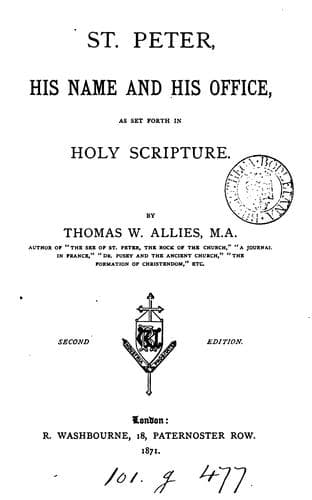
St. Peter, His Name and His Office, as Set Forth in Holy ScriptureAllies, T. W. (Thomas William)
Religion
St. Peter, His Name and His Office, as Set Forth in Holy Scripture
Allies, T. W. (Thomas William)
Peter, the Apostle, Saint
Now here we have to do first, with the interpretation of a series of
dogmatic texts; and, secondly, with a point of doctrine, which,
being of the utmost moment, could not be unknown to any one. But are
these matters on which ancient witnesses, such as the Christian
Fathers, and ecclesiastical writers, can be safely past by unheard?
If it were a matter of geography, chronology, or archaeology, one
might allow it, though with regret: but this is out of the question,
in a matter of dogmatic texts, and those relating to a most
important doctrine. For notorious is the zeal with which the ancient
Fathers laboured to preserve and interpret the dogmatic texts of
Scripture. We know their care to prevent the introduction of new and
false interpretations, and new and false doctrines thence arising.
And we know that, together with the Scriptures, they received from
the Apostolic teaching the kindred power of interpreting them. For,
as Origen remarked, "Since there are many who think that they
believe what is of Christ, and some of them believe what is
different from those before them, yet, since the preaching of the
Church is preserved, as handed down by the order of succession from
the Apostles, and to the present day abiding in the Church, that
verity alone is to be believed, which in nothing is discordant from
the ecclesiastical and Apostolical tradition."[29]
Moreover, can it seem safe to enter upon a track most divergent from
that which the Apostles marked out, and the Christian people
constantly followed? S. Paul[30] taught us to listen to witnesses,
and Christendom, whether assembled in council, or everywhere
diffused, was content to depend on them. Most clear is what is said
on this point about the Fathers at Nicea[31] and Ephesus,[32] and no
less so the words of Leontius[33] of Byzantium, John Cassian,[34]
Theodoret,[35] Augustine,[36] Jerome,[37] Epiphanius,[38] Basil,[39]
Origen,[40] Tertullian,[41] Clement[42] of Alexandria, and the
oldest of all, Irenaeus,[43] who says, "The true knowledge is
the doctrine of the Apostles, and the ancient state of the Church
in the whole world, and the character of the body of Christ,
according to the succession of bishops, by which they handed down
the Church, which is in every place, which hath reached even to us,
being guarded without fiction, _with a most full interpretation of
the Scriptures_, admitting neither addition nor subtraction, and the
reading without falsification, and legitimate and diligent
exposition according to the Scriptures, without danger, and without
blasphemy, and the chief gift of charity, which is more precious
than knowledge, more glorious than prophecy, more eminent than all
graces." For, as he says elsewhere, "We ought to learn the truth,
where the gifts of the Lord are placed; among whom is that
succession of the Church, which is from the Apostles, sound and
irreproachable conversation, and discourse unadulterated and
incorrupt.
Public-domain text, read in full here on John Shaqi.
Reviews
Reviews
No reviews yet
Be the first to share your thoughts on this work.
Elsewhere in the archive
Join the Discussion
Join the discussion
Sign in to leave a comment or review.
Sign InorCreate an account