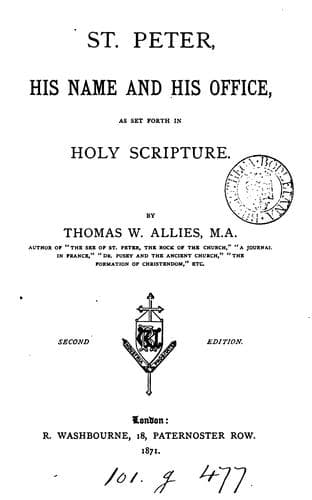
St. Peter, His Name and His Office, as Set Forth in Holy ScriptureAllies, T. W. (Thomas William)
Religion
St. Peter, His Name and His Office, as Set Forth in Holy Scripture
Allies, T. W. (Thomas William)
Peter, the Apostle, Saint
Then, as the bestowal of the new name was the reward of the
obedience with which each had followed his vocation, so God, moved
by their remarkable ensuing faith and charity, explained the dignity
contained in that name, and bestowed it when so explained. The
following refers to the explanation; "By myself have I sworn,
because thou hast done this thing," and "Because flesh and blood
hath not revealed it to thee, but my Father who is in heaven. And I
say unto thee."
But as to the dignity bestowed, it should be remarked that it is
divine, and communicated to each with this resemblance: _First_,
that Abraham thereby becomes the source and parent of all the
faithful, and Peter their base and foundation; the one, the author
of a seed which should equal in number the stars of the heaven and
the sand of the sea; the other, the Rock of the Church, which should
embrace all nations, tribes, and languages. God says to Abraham,
"And multiplying I will multiply thy seed as the stars of heaven and
as the sand which is on the sea-shore." But Christ to Peter, "and
upon this rock I will build my Church." _Secondly_, the blessing
thus bestowed from above upon each was not one which should rest in
their single persons, but from them and through them should be
extended to the universal posterity and society of the faithful; so
that all who should believe, to the consummation of time, should
gain through them blessing, stability, and victory over the assault
of enemies and the gates of hell. The promise to Abraham is clear:
"thy seed shall possess the gate of their enemies, and in thy seed
shall all the nations of the earth be blessed:" nor less so to
Peter, "And the gates of hell shall not prevail against it."
But the high excellence of this dignity, embracing, as it does, the
whole company of the faithful, was presignified in the very meaning
of the name imposed. For of Abraham's name we read, "And thy name
shall be Abraham, for a father of many nations have I made thee."
Exactly resembling is what is said of Peter's appellation, "Thou art
Peter, the Rock, and upon this rock I will build my Church."
Nay, we may put in parallel columns the two promises, thus--
1. Thy name shall be 1. Thou art Peter,
Abraham,
2. For a father of many 2. And upon this rock I
nations have I made thee: will build my Church.
And just as in the former, the second clause contains the reason of
the first, so in the latter likewise the two clauses cohere, as the
name and its explanation. Again, the dignity of the one is expressed
as that of the Father; of the other as that of the Rock. Further,
those alone can share the blessing of Abraham, who are born of his
spirit: and those alone the stability divinely granted to Peter, who
refuse by any violence, or at any cost, to be separated from him.
Public-domain text, read in full here on John Shaqi.
Reviews
Reviews
No reviews yet
Be the first to share your thoughts on this work.
Join the Discussion
Join the discussion
Sign in to leave a comment or review.
Sign InorCreate an account