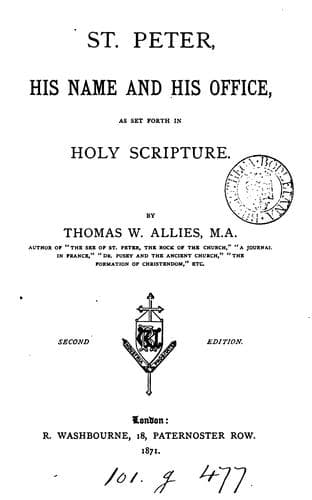
St. Peter, His Name and His Office, as Set Forth in Holy Scripture — John Shaqi
St. Peter, His Name and His Office, as Set Forth in Holy ScriptureAllies, T. W. (Thomas William)
Religion
St. Peter, His Name and His Office, as Set Forth in Holy Scripture
Allies, T. W. (Thomas William)
Peter, the Apostle, Saint
For, indeed, why should they immediately ask this question? The
preceding incident furnishes a natural and sufficient cause. The
Apostles, it seems, were urged by the plainness of Christ's words
and acts to inquire who among them should have the chief authority.
Who will not agree with S. Chrysostome: "The Apostles were touched
with a human infirmity, which the Evangelist too signifies in the
words, 'in that hour,' when He had honoured him (Peter) before them
all. For though of James and John one of the two was the
first-born," (alluding to an opinion that the tax was paid by the
first-born,) "He did nothing like it for them. Hence, being ashamed,
they confessed their excitement of mind, and do not say plainly, Why
hast thou preferred Peter to us? Is he greater than we are? For this
they did not dare; but they ask indefinitely, Who is the greater?
For when they saw three preferred to the rest, they felt nothing
like this; but when one received so great an honour, they were
pained. Nor were they kindled by this alone, but by putting together
many other things. For He had said to him, 'I will give to thee the
keys,' and 'Blessed art thou Simon Bar-jona,' and here 'Give it to
them for Me and for thee;' and also they were pricked at seeing his
confidence and freedom of speech."[13]
Thus their question, if it did not express, at least suggested this
meaning, "Speak more plainly and distinctly whether Peter is to be
the greater and the chief in the Church, and accordingly among us,"
and so they seem to have drawn from our Lord's act a conclusion
which they did not see in the promising or bestowing the prophetic
name of Peter, nor even in the promises conveyed in explaining that
name, and were vexed at the preference shown to him.
And if [14]any be inclined to conclude from hence that our Lord's
words and acts to Peter had not been of any marked significancy,
they should be reminded that the very clearest and plainest things
were sometimes not understood by the Apostles, before the descent of
the Holy Spirit on them. This was specially the case with the things
which they were disinclined to believe. Thus our Lord again and
again foretold to them His passion in express terms, but we are
told, "they understood none of these things."[15] He foretold, too,
His resurrection, yet they did not the least expect it, and they
became at length fully assured of the fact before they remembered
the prediction. Strange as these things seem, yet probably
everyone's private experience will furnish him with similar
instances of a veil being cast upon his eyes, which prevented his
discerning the most evident things, towards which there was
generally some secret disinclination.
Public-domain text, read in full here on John Shaqi.
Reviews
Reviews
No reviews yet
Be the first to share your thoughts on this work.
Join the Discussion
Join the discussion
Sign in to leave a comment or review.
Sign InorCreate an account