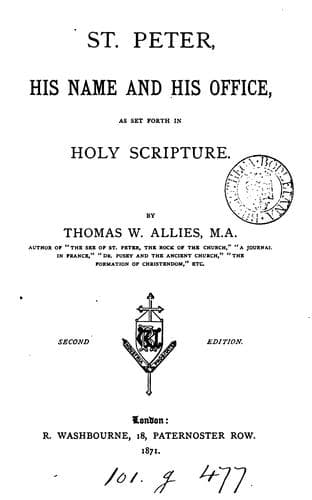
St. Peter, His Name and His Office, as Set Forth in Holy Scripture — John Shaqi
St. Peter, His Name and His Office, as Set Forth in Holy ScriptureAllies, T. W. (Thomas William)
Religion
St. Peter, His Name and His Office, as Set Forth in Holy Scripture
Allies, T. W. (Thomas William)
Peter, the Apostle, Saint
As to the first question there can be no controversy, it being
determined by the words, "confirm _thy brethren_:" and it is plain
from what is said above, that, by brethren, are meant the Apostles.
He had, therefore, the Apostles committed to his charge
_immediately_: but likewise, the rest of all the faithful,
_mediately_. When a person has been named by Christ to confirm the
Apostles expressly, the nature of the case does not allow that the
whole congregation of believers be not in their persons committed to
him. The care of the flock is manifestly involved in the care of the
shepherds: and no one in his senses can doubt that the man who is
charged to support the pillars, is charged to keep in their place
the inferior stones.
And as to the _nature_ of the confirmation, it is for protection
against the fraud of the great enemy. And the danger lay in losing
the faith. Peter, then, is charged to confirm, in such sense that
neither the pillars of the Church, nor its inferior parts, may, by
the loss of faith, be moved from their place, and so severed from
the Church's structure. No charge can be higher than such an office
of confirmation; nor for any thing need we to be more thankful to
our Saviour; but, particularly, nothing can more distinctly shew the
divinely-appointed relation between Peter on the one hand, and on
the other, the rest of the Apostles, and the whole company of the
faithful; nothing define more clearly the special authority of
Peter; that is, to protect and strengthen the unity of the faith,
and to possess all powers needed for such protection.
This charge was given after that by the prayer of Christ the
privilege had been gained for Peter's faith, _that it should never
fail_. Hence, that faith is become, in virtue of such prayer, the
infallible standard of evangelical truth: as S. Cyprian expressed it
of old, "that faith of the Romans, which perfidy _cannot_
approach."[40] It follows that all the faithful owe to it obedience.
And Peter's authority rests on a double title, _external_ of
mission, _internal_ of spiritual gift: the former contained in the
words of Christ the legislator, "And thou,[41] in thy turn, one day
confirm thy brethren:" the latter, in the words of Christ, the
bestower of all gifts, "But I have prayed for thee, that thy faith
fail not."
Public-domain text, read in full here on John Shaqi.
Reviews
Reviews
No reviews yet
Be the first to share your thoughts on this work.
Join the Discussion
Join the discussion
Sign in to leave a comment or review.
Sign InorCreate an account