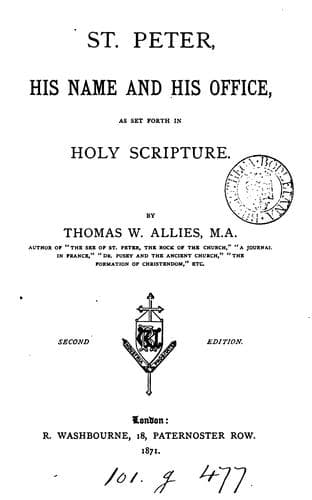
St. Peter, His Name and His Office, as Set Forth in Holy ScriptureAllies, T. W. (Thomas William)
Religion
St. Peter, His Name and His Office, as Set Forth in Holy Scripture
Allies, T. W. (Thomas William)
Peter, the Apostle, Saint
That these terms, which contain Peter's prerogatives really do
express jurisdiction and authority, may be thus very briefly shown.
The first, "Thou art Peter, and upon this rock I will build My
Church," is drawn from architecture, exhibiting between Peter and
the Church, which includes also the Apostles, the relation which
exists between the foundation and the superstructure. This is one of
dependence, by which accordingly the Apostles must maintain an
indivisible union with Peter. Which relation of dependence, again,
cannot be understood without the notion of superior jurisdiction in
Peter, for these are correlative. The second term corroborates this;
for it is a plain duty, and undoubted moral obligation, to be united
to him, if severed from whom, the words of Christ do not entitle you
to expect stability or victory over the gates of hell. Now, "the
gates of hell shall not prevail against it," most plainly express
that perseverance and victory are promised to no one by Christ, who
does not remain joined with Peter. So much for the _duty_ which
binds all Christians, and the Apostles among them, to avoid
separation from Peter as their destruction. But such duty involves
the faculty and authority on Peter's part of enjoining on all
without exception the maintenance of unity, and of keeping from the
whole body the sin of schism, which, again, expresses his superior
jurisdiction. Yet plainer and more striking is the _third_; for in
the words, "And I will give to thee the keys of the kingdom of
heaven," it is foretold that Peter, in regard to the kingdom of
heaven, and therefore to all Christians, whether teachers or taught,
subjects or prelates, shall discharge the office of the bearer of
the keys; with which jurisdiction and authority are indivisibly
united. But in the _fourth_, there is no matter relating to the
heavenly kingdom, which is not subjected by this promise to Peter's
authority. "Whatsoever thou shalt bind," "whatsoever thou shalt
loose;" but this is in its own kind without limit, a full
legislative and judicial power. Thus these four terms exactly agree
with each other, and express, severally and collectively,
prerogatives by which Peter is admitted to a singular and close
association with Christ; and therefore is pre-eminent among the
Apostles by his Primacy, and his superior authority over the whole
Church.
Public-domain text, read in full here on John Shaqi.
Reviews
Reviews
No reviews yet
Be the first to share your thoughts on this work.
Elsewhere in the archive
Join the Discussion
Join the discussion
Sign in to leave a comment or review.
Sign InorCreate an account