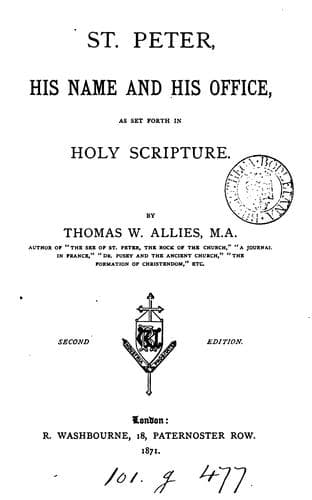
St. Peter, His Name and His Office, as Set Forth in Holy ScriptureAllies, T. W. (Thomas William)
Religion
St. Peter, His Name and His Office, as Set Forth in Holy Scripture
Allies, T. W. (Thomas William)
Peter, the Apostle, Saint
They also show, with no less clearness, that Christ in bestowing
these prerogatives and primacy on Peter, designed to produce the
visible unity of His kingdom and Church; and this in two ways, the
first _typically prefiguring_ the Church's own unity in Peter, the
single Foundation, Bearer of the keys, and supreme Legislator and
Judge; the second _efficiently_, as by a principle and cause,
_forming_, _holding together_, and _protecting_, visible unity in
that same Peter, as he discharged these functions. For just as the
building is based on the foundation, and by virtue of it all the
parts are held together, so a kingdom's unity and harmonious
administration are first _moulded out_, and then _preserved_, in the
unity of its supreme authority.
And this Primacy may be regarded from three different points of
view; as it _is in itself_, and as it regards its _efficient_ and
its _final_ cause. As to the first, it consists in superior
jurisdiction and authority; as to the second, it springs from Christ
Himself, who said to Peter alone, "And I too say unto thee," &c.; as
to the third, it _prefigures_, _forms_, and _protects_ the Church's
visible unity.
But to prefigure, to form, and to protect the Church's unity being
distinct functions, care must be taken not to confuse them, the
former concerning the Primacy as a type, the two latter as the
origin and efficient cause; and also not to concede the former while
the latter are denied, which latter make up the Primacy as
jurisdictional, and the instrument effecting unity. Now Peter is
both the type of unity, its origin, and its efficient cause.
A long line[23] of fathers, from the most ancient downwards, regards
Peter as at once the type, and the origin, and efficient cause of
unity; setting it forth as a prerogative of his headship that no
one, whether Apostle, or Prophet, or Evangelist, or Doctor, or
Teacher, might separate from him without the crime of schism. In
this consists his Primacy, and in this the famous phrase of S.
Cyprian finds its solution, that "the Episcopate is one, of which a
part is held by each without division of the whole."
And, what is like to the preceding, they hold that Peter is the
_continuous_ source of all power in the Church, and that while its
plenitude dwells in his person, a portion of it is derived to the
various prelates under him. No one has set this forth more fully
than S. Leo, in the middle of the fifth century, as where he says,
that "if Christ willed that other rulers should enjoy aught together
with him, (that is, Peter,) yet never did He give, _save through
him_, what He denied not to others."[24]
There is no one of these consequences but seems to result from the
words of our Lord here solemnly addressed to Peter.
Public-domain text, read in full here on John Shaqi.
Reviews
Reviews
No reviews yet
Be the first to share your thoughts on this work.
Elsewhere in the archive
Join the Discussion
Join the discussion
Sign in to leave a comment or review.
Sign InorCreate an account