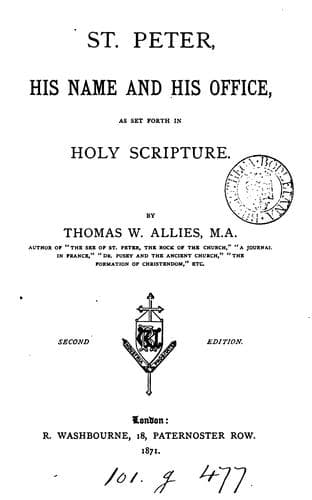
St. Peter, His Name and His Office, as Set Forth in Holy ScriptureAllies, T. W. (Thomas William)
Religion
St. Peter, His Name and His Office, as Set Forth in Holy Scripture
Allies, T. W. (Thomas William)
Peter, the Apostle, Saint
But if our Lord's preference of Peter, as to rank and dignity in the
Church, was during his lifetime consistent and uniform; if,
moreover, He made to him, twice, promises so large as to include and
go far beyond all that He said to the Apostles in common; and if He
took out, as it were, of what He had first promised to Peter a
portion which He afterwards promised as their common inheritance to
the rest; His dealing with Peter and the Apostles after His
resurrection is the exact counterpart to this. The fulfilment is
equivalent to the promise. In the fourfold prophecy to Peter, in
Matt. xvi. the last member is, "And whatsoever thou shalt bind on
earth, it shall be bound also in heaven; and whatsoever thou shalt
loose on earth, it shall be loosed also in heaven." That this is a
grant of full legislative and judicial power, given to one, we have
seen. Now on a later occasion it is repeated to the twelve together,
Matt. xviii. 18. _But the other three members of the prophecy made
to Peter are never repeated to the twelve_. In the fulfilment the
same distinction takes place. To the twelve in common our Lord
communicates the power contained in the fourth member of His
original promise, saying, John xx. 21, "As the Father hath sent Me,
I also send you. Receive ye the Holy Ghost: whose sins ye shall
forgive, they are forgiven them: and whose sins ye shall retain,
they are retained:" to which the other forms contained in Matt.
xxviii. 18, Mark xvi. 15, Luke xxiv. 49, Acts i. 4, 8, of preaching
the Gospel to every creature, of waiting for the power of the Holy
Ghost wherewith they should be endued, of teaching men to observe
all things which He had commanded, are equivalent, though less
definite. _But nowhere are the powers contained in the first three
members of the prophecy to Peter communicated to the twelve_. As the
promises were made to Peter alone originally, so to Peter alone are
they, as we shall see, fulfilled. Indeed, it could not be otherwise,
for the promises to be the rock of the Church, by coherence with
which the Church should be impregnable, and the bearer of the keys,
are in their own nature confined to one, and exclusive of
participants, and once made by the very Truth Himself to one man,
they ranged under his power all his brethren: "For the promises of
Jesus Christ, as well as His gifts, are without repentance; and what
is once given indefinitely and universally is irrevocable."[26]
Besides that, another indisputable principle must be taken into
account, viz., "that power given to several carries its restriction
in its division:" just as if a king before his death bequeaths the
whole administration of his sovereignty to a board of twelve
councillors, though the sum of authority so conveyed be sovereign,
yet the share of each individual in the college will be restricted
by the equal right of his colleagues. Whereas "power given to one
alone, and over all, and without exception, carries with it
Public-domain text, read in full here on John Shaqi.
Reviews
Reviews
No reviews yet
Be the first to share your thoughts on this work.
Elsewhere in the archive
Join the Discussion
Join the discussion
Sign in to leave a comment or review.
Sign InorCreate an account