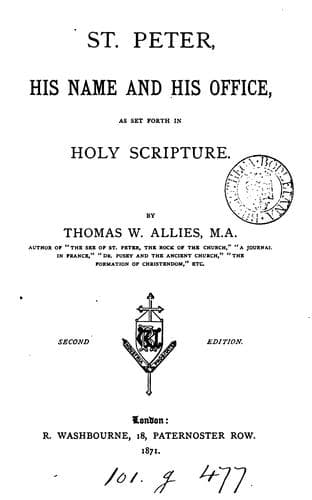
St. Peter, His Name and His Office, as Set Forth in Holy ScriptureAllies, T. W. (Thomas William)
Religion
St. Peter, His Name and His Office, as Set Forth in Holy Scripture
Allies, T. W. (Thomas William)
Peter, the Apostle, Saint
plenitude, and, not having to be divided with any other, it has no
bounds save those which its terms convey." Such was the power
originally promised to Peter; and such, no less, that which was
ultimately conveyed. He stands apart and alone no less in the
fulfilment than in the promise. And under another image, but one
equally expressive with the first, the Lord conveys an authority as
absolute and as exclusive. The "bounds which its terms convey" are
the whole fold of Christ: "the sheep" no less than "the lambs:" "to
govern" no less than "to feed."[27] As the great Architect of the
heavenly city said to Peter, "Thou art the Rock;" as "the King of
kings," who "hath the key of David," and "on whose shoulder is the
government," said to Peter, "To thee will I give the keys of the
kingdom of heaven;" as He "who upholdeth all things by the word of
His power," and "in whom all things consist," said to Peter,
"Confirm thy brethren:" so to the same Peter, the same "Great
Shepherd of the sheep," said, "Feed My lambs, be shepherd over My
sheep," thus committing to him the chief Apostles themselves who
heard this charge, and causing there to be for ever "one fold and
one shepherd," on earth as in heaven.
It remains briefly to consider these three palmary texts in their
reciprocal relations to each other, by which the fullest light is
thrown upon the scriptural prerogatives of S. Peter.
1. First, then, all these texts are in the most marked manner
circumscribed to Peter _alone_. In all he is addressed by name; in
all he is distinguished by other circumstances from his brethren at
the time present with him; in all a special condition is attached
belonging to him; in the first, superior faith--in the second,
faith, which, by a particular gift, the fruit of Christ's own
prayer, should never fail--in the third, superior love. So that,
without an utter disregard of the meaning of words, and the force of
the context, and every law of grammar and philology, no one of these
texts can be extended from its application to Peter alone, and made
common to the other Apostles.
Public-domain text, read in full here on John Shaqi.
Reviews
Reviews
No reviews yet
Be the first to share your thoughts on this work.
Elsewhere in the archive
Join the Discussion
Join the discussion
Sign in to leave a comment or review.
Sign InorCreate an account