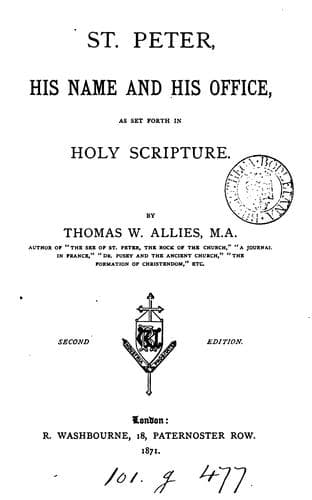
St. Peter, His Name and His Office, as Set Forth in Holy ScriptureAllies, T. W. (Thomas William)
Religion
St. Peter, His Name and His Office, as Set Forth in Holy Scripture
Allies, T. W. (Thomas William)
Peter, the Apostle, Saint
individual member: he was set up especially for the compacting of
each spiritual joint, the harmony and cohesion of the whole. Here,
then, the office of the universal Pastor or Teacher is precisely
equivalent to him, who, by another image confirms, strengthens,
consolidates his brethren. Thus, in the second text Christ foretold
the third. But the more we contemplate all the three in their mutual
relations, the more a certain thought suggests itself to the mind.
There is a special doctrine concerning the most Holy Trinity, the
most distinctive of that great mystery, which expresses the
reciprocal indwelling of the Three Persons. Now something analogous
may be said of the way in which these three texts impermeate and
include each other, of their exact equivalence, and distinct, but
inseparable force: of whom one is said, of the same must all.
4. Fourthly, they all indicate a _sovereign_ authority,
_independent_ itself, but on which all others depend; symbolising
power from above, but claiming obedience from below; immutable in
itself, but by which all the rest are made proof against change; for
it is not to the sheep that the shepherd is responsible, but to
their owner. It has been said throughout that the one special mark
of Peter's distinction was a peculiar association with Christ. It is
not therefore by any infringement of equal rights that this
authority is set up, but as the representative, the vicegerent, of
Him in whom all power dwells: who bore this authority in His own
body, and who committed to another what was first His own, both by
creation and by purchase--"Feed _My_ sheep." In all these texts the
immediate transference of authority from the Person of the God-man
is most striking; in Peter He inaugurates His great theandric
dispensation, and forms the Body which He was to leave on earth.
Thus these texts most clearly express that important doctrine of
antiquity, the keystone of the Church's liberty from the world,
which is the reason why the world so hates it, "The first See is
judged by no man." So entirely have political ideas and jealousies
infected our mode of judging of spiritual things--to such a degree
is our peculiar civil liberty made the standard of Church
government--that it is necessary to insist again and again on what
to Christians ought to be a first principle, viz., that "all power
and jurisdiction in the Church, like the Church herself, ought to
rest not upon natural and human authority, but on the divine
authority of Christ. This is the reason why we may pronounce no
otherwise concerning such jurisdiction, than we know has been handed
down from Christ, its proper author and founder. Now it is certain
that at the same moment at which Christ instituted the community
called the Church, such a power was introduced, and entrusted as
well to Peter singly as the head, as to the Apostles under him. Nay,
that power was fixed and constituted, and its ministers and bishops
Public-domain text, read in full here on John Shaqi.
Reviews
Reviews
No reviews yet
Be the first to share your thoughts on this work.
Elsewhere in the archive
Join the Discussion
Join the discussion
Sign in to leave a comment or review.
Sign InorCreate an account