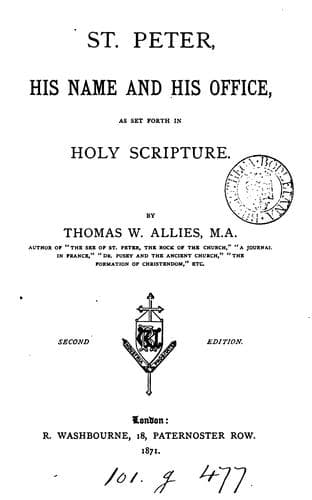
St. Peter, His Name and His Office, as Set Forth in Holy ScriptureAllies, T. W. (Thomas William)
Religion
St. Peter, His Name and His Office, as Set Forth in Holy Scripture
Allies, T. W. (Thomas William)
Peter, the Apostle, Saint
marked out, _before_ the Church, that is, the whole body and
commonwealth, had grown into coherence. And so ecclesiastical
jurisdiction did not first dwell in the community itself, and was
then translated by a sort of popular suffrage and consent to its
magistrates; but from the very first origin Peter was destined to be
single chief of the future body, and next to him the other
Apostles."[30]
5. Fifthly, it must be observed that there is a _definiteness_ about
these texts which belongs in a far less degree to those forms in
which the co-ordinate and co-equal authority of the Apostles, as
such, is expressed. This last is left to be harmonised and brought
into operation by the superior power of the chief. They are indeed
sent into all the world, they are immediately instituted by our
Lord, they have the promise that His power shall be with them, and
that their sentence shall stand good in heaven and on earth; but
this promise, which is the most distinct made to them, has been
already gathered up into the hands of one, and in its practical
issue is limited by the necessity of cooperating with that one; that
is, the authority of Peter includes and embraces theirs, but theirs
is ranged under his. Theirs is modified not only by being shared,
but by having his set over them. Now observe how distinct and clear,
how definite in their meaning, while universal in their range, are
the things said of him alone; 1. That he should be the rock on which
Christ would build His Church; 2. That permanence and victory should
belong to that Church for ever through Him: 3. That he should bear
the keys in the kingdom of heaven: 4. That whatever _singly_ he
should bind and loose, should be bound and loosed in heaven as well
as on earth: 5. That he should confirm his brethren, the Apostles
themselves being the very first so called: 6. That he should be the
Shepherd of the fold. What can constitute inequality between two
parties, if such a series of promises given to one, and not to the
other, does not?
Public-domain text, read in full here on John Shaqi.
Reviews
Reviews
No reviews yet
Be the first to share your thoughts on this work.
Elsewhere in the archive
Join the Discussion
Join the discussion
Sign in to leave a comment or review.
Sign InorCreate an account