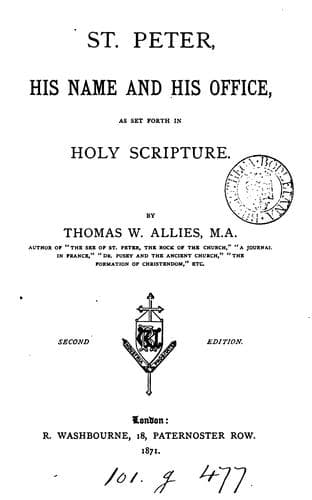
St. Peter, His Name and His Office, as Set Forth in Holy ScriptureAllies, T. W. (Thomas William)
Religion
St. Peter, His Name and His Office, as Set Forth in Holy Scripture
Allies, T. W. (Thomas William)
Peter, the Apostle, Saint
The [1]purpose of S. Luke in writing the Acts seems to have been to
set before us the labours and sufferings of the Apostles in planting
and propagating the Church. But he has divided the book very
distinctly into two portions; the latter, from the thirteenth
chapter to the end, with one short exception, is wholly occupied
with the labours of S. Paul, "the vessel of election," in spreading
the faith among the Gentiles, and so contains the particular history
of that Apostle, and the churches founded by him. The former, from
the beginning to the end of the twelfth chapter, embraces the
history of the Apostles in common, and of the whole Church, as it
rose at Jerusalem, and was spread first in Judea, then in Samaria,
and finally extended to the Gentiles. The former history, then, is
universal; the latter, particular.
Moreover, to use the words of [2]S. Chrysostome, "we may here see
the promises which Christ made in the Gospels carried into
execution, and the bright light of truth shining in the very
actions, and a great change in the disciples, arising from the
Spirit that had entered into them.--You will see here Apostles
speeding on the wing over land and sea, and men once timid and
unskilled suddenly changed into despisers of wealth, and conquerors
of glory and all other passions; you will see them united in the
utmost harmony, without jealousy, which once they had, without
contention for the higher place."
We may say, then, in a word, that the Gospels are a history of the
Head, and the Acts of the mystical Body. Hence both issue forth from
one and the same fountain and source. The history of the Head begins
with the descent of the Holy Ghost, whereby Christ was conceived,
and [3]"the race of God and of man became one. For just as the union
of man with woman joins two families, so upon Christ assuming flesh,
by that flesh the whole Church became of kin with Christ, Paul
became Christ's kinsman, and Peter, each one of the faithful, all
we, every holy person. Therefore, says Paul, [4]'being the offspring
of God,' and again, 'we are the body of Christ and members in
particular,' that is, through the flesh, which He has assumed, we
are His kinsmen." Now the history of the Body, proceeding from the
same fountain-head, sets before us the Holy Spirit, who, by
descending first on the teachers, and afterwards on the disciples,
exalts and advances all, and by imparting Himself, imparts "the
proportional deification of man," that is, "the utmost possible
assimilation and union with God."[5] For "the Spirit works in us by
His proper power, truly sanctifying, and uniting us to Himself into
one frame, and making us partakers of the divine nature:"[6]
"becoming as it were a quality of the Godhead in us, and dwelling in
the saints, and abiding for ever."
Public-domain text, read in full here on John Shaqi.
Reviews
Reviews
No reviews yet
Be the first to share your thoughts on this work.
Elsewhere in the archive
Join the Discussion
Join the discussion
Sign in to leave a comment or review.
Sign InorCreate an account