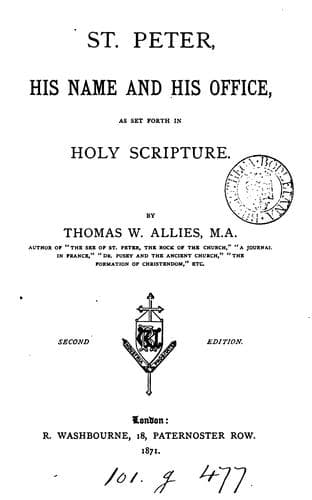
St. Peter, His Name and His Office, as Set Forth in Holy ScriptureAllies, T. W. (Thomas William)
Religion
St. Peter, His Name and His Office, as Set Forth in Holy Scripture
Allies, T. W. (Thomas William)
Peter, the Apostle, Saint
Now it is [7]manifest that if the first twelve chapters of the Acts
contain the history of the Church from its beginning, and what the
Apostles did for its first formation, its growth, and its form of
government, all this has the closest connection with the question as
to Peter's prerogatives. For the historical accounts in the Acts,
which exhibit the _execution_ of Christ's promises and intentions,
naturally tend to set in the fullest light, and to reveal
distinctly, whatever as to the administration of the Church may be
less clearly _foretold_ in the Gospels. For in itself the
_execution_ is declaratory of the _enactment_, and supplies a safe
rule for understanding and determining the words of institution.
Now, if we apply this rule to the present question, it will be
apparent that those expressions of the Gospel, which we assigned to
the divine institution of the Primacy, cannot be otherwise received
without making the _execution_ in the Acts at variance with what the
Gospels record.
For, take it as a still doubtful hypothesis whether there exist
evangelical testimonies of Peter's _institution_ to be head and
chief of the Apostles. What needs it to turn this hypothesis into
certainty? What should we expect of Peter, if he really had received
from Christ the charge of leading the other Apostles? What but that
he should never follow, but always be at the head; should close
dissensions, weigh and terminate controversies, punish emergent
offences, maintain the general discipline, give the support of his
counsel and authority in need, and leave undone none of those
functions which accompany the office of head and supreme ruler?
Hence it is plain that there are two ways, the one absolute, the
other hypothetical, by which a decisive judgment may be drawn from
the history of the Acts, as to whether Peter's Primacy was
instituted in the Gospels. Critics and philosophers are perpetually
using both these tests. Thus, the former, "if a certain work--say
the epistles of the martyr Ignatius--be genuine, it ought to contain
certain characteristics. But it does contain these, and so is
genuine." Or absolutely, "a certain work, the Epistles of Ignatius,
contains all which we should expect in a genuine work, therefore it
is genuine." The latter infer, "If bodies be moved by the law of
gravitation, they would pass through a certain space under such and
such a condition. But this they do, and accordingly are moved by
gravitation." Or absolutely, "Bodies left to themselves pass through
space under such conditions as they would follow, if impelled by
gravitation. Accordingly they are so impelled." Now in the parallel
case, "If Christ in the Gospels pre-ordained a form of Church
government, which gathered up the supreme power and visible headship
into Peter's hands, the _exercise_ of such _institution_ ought to be
found in the Acts. But it is so found. Therefore," &c.--or again,
"No one would expect certain acts from Peter, unless he were the
Public-domain text, read in full here on John Shaqi.
Reviews
Reviews
No reviews yet
Be the first to share your thoughts on this work.
Elsewhere in the archive
Join the Discussion
Join the discussion
Sign in to leave a comment or review.
Sign InorCreate an account