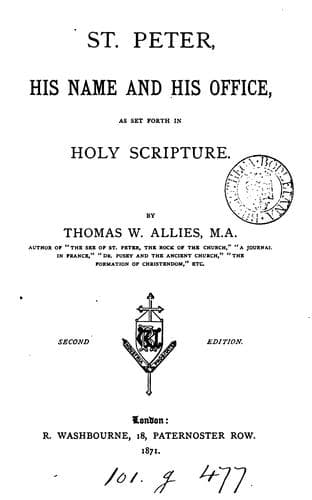
St. Peter, His Name and His Office, as Set Forth in Holy ScriptureAllies, T. W. (Thomas William)
Religion
St. Peter, His Name and His Office, as Set Forth in Holy Scripture
Allies, T. W. (Thomas William)
Peter, the Apostle, Saint
latter part of the book, when the historian turns away from the
general history of the Church to record his particular labours, in
which, no doubt, the object was to show the progress of the Church
among the Gentiles; but with regard to the part which is common to
the whole Church, another thought is suggested. The history of what
Peter taught and did, to build up and extend the Church, is
considered the common history of the Apostles, and so inscribed as
their Acts. But can this be called an _accurate_ expression, unless
Peter had been the head of the Apostles? It is very plain that the
acts of a head are imputed to the whole body; to a college of
brethren, what its chief executes; to a city or kingdom, the deeds
of its prince. But it is not plain how this can be, if the actor be
one of a number, and do not exceed his brethren in honour or
dignity. Therefore the Acts of Peter could be called, generally, the
Acts of the Apostles, only because they were considered the Acts of
their head.
Now let us pass from the general view to that in detail.
I. After [16]the Lord's ascension a most important point immediately
arose, whether, that is, the number of the Twelve was to be filled
up by the election of a new Apostle to take the place of Judas. The
will of Christ on this matter was to be learnt; a witness was to be
chosen who should participate in the mission of Christ Himself,
according to the words, "As the Father hath sent Me, I also send
you," and carry the light of the Gospel to the ends of the world;
and one was to be elected to the dignity of the Apostolate, the
highest rank in the Church. It was, therefore, so important a
matter, that no one could undertake it save he who had received the
vicarious headship of our Lord Himself. Now the history in the Acts
tells us that Peter alone spoke on the subject of substituting a
fresh Apostle for Judas; Peter alone proved from Scripture the
necessity of the election, defined the conditions of eligibility,
and appointed the mode of election, and presided over and directed
the whole transaction.
Public-domain text, read in full here on John Shaqi.
Reviews
Reviews
No reviews yet
Be the first to share your thoughts on this work.
Elsewhere in the archive
Join the Discussion
Join the discussion
Sign in to leave a comment or review.
Sign InorCreate an account