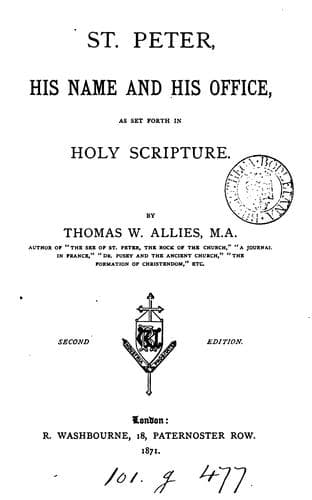
St. Peter, His Name and His Office, as Set Forth in Holy ScriptureAllies, T. W. (Thomas William)
Religion
St. Peter, His Name and His Office, as Set Forth in Holy Scripture
Allies, T. W. (Thomas William)
Peter, the Apostle, Saint
5. To this we must likewise refer it that Luke, while he amply
describes actions which belong to Peter, rather hints at than
narrates what concerns the other Apostles. Thus he leaves it to be
understood that the others spoke, while he gives Peter's discourses
entire, and seems to have chosen them as the principal material of
his history. He simply suggests that miracles were wrought by the
rest, but records particularly what Peter did for the establishment
of the faith. He relates but very little of those who became
Christians by the exertion of others, but notes at large the
abundant fruit of Peter's teaching. Take an ancient author's summary
of the Acts, "this whole volume is about the ascension of Christ
after the resurrection, and about the descent of the Holy Spirit on
the holy Apostles, and how and where the disciples announced
Christ's religion, and all the wondrous deeds which they did by
prayer and faith in Him, and about Paul's divine calling from
heaven, his apostleship, and fruitful preaching, and in a word about
those many great dangers which the Apostles underwent for
Christ:"[13] follow, out of this, all which concerns the universal
Church in the first twelve chapters, and Peter will be found not
only the principal, but well nigh the only, figure in the
foreground.
6. Hence as the Gospels may be called the history of Christ, so this
first part of the Acts may be called the history of Peter; for as
Christ occupies each page of the Gospels, so Peter here. Nothing can
be more emphatic or more just than S. Chrysostome's words: "Behold
him making his rounds on every side, and the first to be found; when
an Apostle was to be chosen, he was the first; when the Jews were to
be told that they were not drunken; when the lame man was to be
healed; when the multitude was to be addressed, he is before the
rest; when they had to do with the rulers, it is he; when with
Ananias, when healings took place from the shadow, still it is he.
Where there was danger, it is he, and where there was dispensation;
but when all is tranquil, they act in common. He sought not the
greater honour. But again, when miracles are to be worked, he comes
forth before the rest."[14] What can prove Peter's pre-eminence if
this does not? But his words on another occasion deserve mention.
Alluding to the title "Acts of the Apostles," which seems to promise
their common history, he observes, "Yet if you search accurately,
the first part of the book exhibits Peter's miracles and teaching,
but little on the part of the other Apostles; and after this the
whole account is spent on Paul." But he adds, "How are they the acts
of all the Apostles? Because, according to Paul, when one member is
glorified, all the members are glorified with it, the historian did
not entitle them, the Acts of Peter and of Paul, but the Acts of the
Apostles; the promise of the writer includes them all."[15] Now
every one must feel the very high distinction given to Paul in the
Public-domain text, read in full here on John Shaqi.
Reviews
Reviews
No reviews yet
Be the first to share your thoughts on this work.
Elsewhere in the archive
Join the Discussion
Join the discussion
Sign in to leave a comment or review.
Sign InorCreate an account