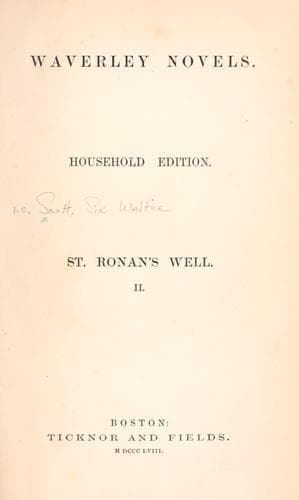
Black humor; Country life -- Fiction; Historical fiction; Scotland -- Fiction
We have seldom found Sydney Smith giving higher praise, and nobody can
deny the justice of the censure with which it is qualified. Scott
himself explains, in his Introduction, how, in his quest of novelty, he
invaded modern life, and the domain of Miss Austen. Unhappily he proved
by example the truth of his own opinion that he could do "the big
bow-wow strain" very well, but that it was not his _celebrare domestica
facta_. Unlike George Sand, Sir Walter had humour abundantly, but, as
the French writer said of herself, he was wholly destitute of _esprit_.
We need not linger over definition of these qualities; but we must
recognise, in Scott, the absence of lightness of touch, of delicacy in
the small sword-play of conversation. In fencing, all should be done,
the masters tell us, with the fingers. Scott works not even with the
wrist, but with the whole arm. The two-handed sword, the old claymore,
are his weapons, not the rapier. This was plain enough in the
word-combats of Queen Mary and her lady gaoler in Loch Leven. Much more
conspicuous is the "swashing blow" in the repartee of "St. Ronan's." The
insults lavished on Lady Binks are violent and cruel; even Clara Mowbray
taunts her. Now Lady Binks is in the same parlous case as the
postmistress who dreed penance "for ante-nup," as Meg Dods says in an
interrupted harangue, and we know that, to the author's mind, Clara
Mowbray had no right to throw stones. All these jeers are offensive to
generous feeling, and in the mouth of Clara are intolerable. Lockhart
remarked in Scott a singular bluntness of the sense of smell and of
taste. He could drink corked wine without a suspicion that there was
anything wrong with it. This curious obtuseness of a physical sense, in
one whose eyesight was so keen, who, "aye was the first to find the
hare" in coursing, seems to correspond with his want of lightness in the
invention of _badinage_. He tells us that, for a long while at least, he
had been unacquainted with the kind of society, the idle, useless
underbred society, of watering-places. Are we to believe that the
company at Gilsland, for instance, where he met and wooed Miss
Charpentier, was like the company at St. Ronan's? Lockhart vouches for
the snobbishness, "the mean admiration of mean things," the devotion to
the slimmest appearances of rank. All this is credible enough, but, if
there existed a society as dull and base as that which we meet in the
pages of "Mr. Soapy Sponge," and Surtees's other novels, assuredly it
was no theme for the great and generous spirit of Sir Walter. The worst
kind of manners always prevail among people whom moderns call "the
second-rate smart," and these are drawn in "St. Ronan's Well." But we
may believe that, even there, manners are no longer quite so hideous as
in the little Tweedside watering-place. The extinction of duelling has
destroyed, or nearly destroyed, the swaggering style of truculence;
people could not behave as Mowbray and Sir Bingo behave to Tyrrel, in
Public-domain text, read in full here on John Shaqi.
Reviews
Reviews
No reviews yet
Be the first to share your thoughts on this work.
Join the Discussion
Join the discussion
Sign in to leave a comment or review.
Sign InorCreate an account