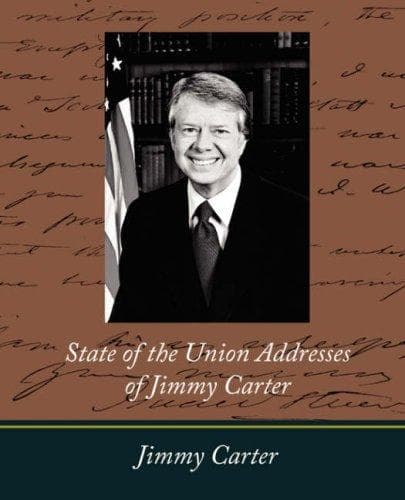
Presidents -- United States -- Messages; United States -- Politics and government -- Sources
The multilateral trade negotiations are now reaching a successful
conclusion, and congressional approval is essential to the economic
well-being of our own country and of the world. This will be one of our top
priorities in 1979.
We are entering a hopeful era in our relations with one-fourth of the
world's people who live in China. The presence of Vice Premier Deng
Xiaoping next week will help to inaugurate that new era. And with prompt
congressional action on authorizing legislation, we will continue our
commitment to a prosperous, peaceful, and secure life for the people of
Taiwan.
I'm grateful that in the past year, as in the year before, no American has
died in combat anywhere in the world. And in Iran, Nicaragua, Cyprus,
Namibia, and Rhodesia, our country is working for peaceful solutions to
dangerous conflicts.
In the Middle East, under the most difficult circumstances, we have sought
to help ancient enemies lay aside deep-seated differences that have
produced four bitter wars in our lifetime.
Our firm commitment to Israel's survival and security is rooted in our
deepest convictions and in our knowledge of the strategic importance to our
own Nation of a stable Middle East. To promote peace and reconciliation in
the region, we must retain the trust and the confidence both of Israel and
also of the Arab nations that are sincerely searching for peace.
I am determined, as President, to use the full, beneficial influence of our
country so that the precious opportunity for lasting peace between Israel
and Egypt will not be lost.
The new foundation of international cooperation that we seek excludes no
nation. Cooperation with the Soviet Union serves the cause of peace, for in
this nuclear age, world peace must include peace between the super
powers--and it must mean the control of nuclear arms.
Ten years ago, the United States and the Soviet Union made the historic
decision to open the strategic arms limitations talks, or SALT. The purpose
of SALT, then as now, is not to gain a unilateral advantage for either
nation, but to protect the security of both nations, to reverse the costly
and dangerous momentum of the nuclear arms race, to preserve a stable
balance of nuclear forces, and to demonstrate to a concerned world that we
are determined to help preserve the peace.
The first SALT agreement was concluded in 1972. And since then, during 6
years of negotiation by both Republican and Democratic leaders, nearly all
issues of SALT II have been resolved. If the Soviet Union continues to
negotiate in good faith, a responsible SALT agreement will be reached.
It's important that the American people understand the nature of the SALT
process.
SALT II is not based on sentiment; it's based on self-interest--of the
United States and of the Soviet Union. Both nations share a powerful common
interest in reducing the threat of a nuclear war. I will sign no agreement
which does not enhance our national security.
Public-domain text, read in full here on John Shaqi.
Reviews
Reviews
No reviews yet
Be the first to share your thoughts on this work.
Join the Discussion
Join the discussion
Sign in to leave a comment or review.
Sign InorCreate an account