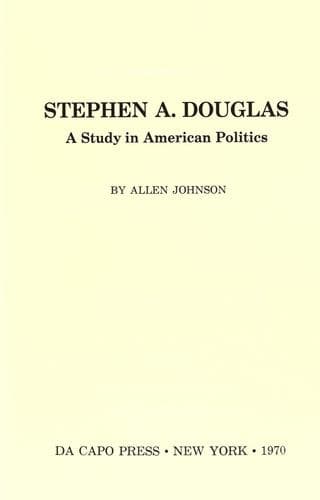
Stephen A. Douglas: A Study in American PoliticsJohnson, Allen
History
Stephen A. Douglas: A Study in American Politics
Johnson, Allen
Douglas, Stephen A. (Stephen Arnold), 1813-1861
This contest ended, the anti-slavery sentiment evaporated. The "Black
Laws" continued in force. Little or no interest was manifested in the
fate of indentured black servants, who were to all intents and
purposes as much slaves as their southern kindred. The leaven of
Abolitionism worked slowly in Illinois society. By an almost unanimous
vote, the General Assembly adopted joint resolutions in 1837 which
condemned Abolitionism as "more productive of evil than of moral and
political good." There were then not a half-dozen anti-slavery
societies in the State, and these soon learned to confine their labors
to central and northern Illinois, abandoning Egypt as hopelessly
inaccessible to the light.[312]
The issues raised by the Mexican War and the prospective acquisition
of new territory, materially changed the temper of northern Illinois.
Moreover, in the later forties a tide of immigration from the
northeastern States, augmented by Germans who came in increasing
numbers after the European agitation of 1848, was filling the
northernmost counties with men and women who held positive convictions
on the question of slavery extension. These transplanted New
Englanders were outspoken advocates of the Wilmot Proviso. When they
were asked to vote upon that article of the Constitution of 1848 which
proposed to prevent the immigration of free negroes, the fourteen
northern counties voted no, only to find themselves outvoted two to
one.[313] A new factor had appeared in Illinois politics.
Many and diverse circumstances contributed to the growth of
sectionalism in Illinois. The disruptive forces, however, may be
easily overestimated. The unifying forces in Illinois society were
just as varied, and in the long run more potent. As in the nation at
large so in Illinois, religious, educational, and social organizations
did much to resist the strain of countervailing forces. But no
organization proved in the end so enduring and effective as the
political party. Illinois had by 1840 two well-developed party
organizations, which enveloped the people of the State, as on a large
scale they embraced the nation. These parties came to have an
enduring, institutional character. Men were born Democrats and Whigs.
Southern and Northern Whigs, Northern and Southern Democrats there
were, of course; but the necessity of harmony for effective action
tended to subordinate individual and group interests to the larger
good of the whole. Parties continued to be organized on national
lines, after the churches had been rent in twain by sectional forces.
Of the two party organizations in Illinois, the Democratic party was
numerically the larger, and in point of discipline, the more
efficient. It was older; it had been the first to adopt the system of
State and district nominating conventions; it had the advantage of
prestige and of the possession of office. The Democratic party could
"point with pride" to an unbroken series of victories in State and
presidential elections.
Public-domain text, read in full here on John Shaqi.
Reviews
Reviews
No reviews yet
Be the first to share your thoughts on this work.
Elsewhere in the archive
Join the Discussion
Join the discussion
Sign in to leave a comment or review.
Sign InorCreate an account